
• Skip to primary navigation
  • Skip to main content
  • Skip to footer
Picisoclogo

PICISOC.niue.nu

The Internet Society in the Pacific

Search

Search DropdownSearch Icon Join
  • Home
  • About Us
    • What is PICISOC?
    • History of PICISOC
    • PICISOC Members
    • Code of Conduct
    • PICISOC Netiquette Guidelines
  • Board Business
    • Current PICISOC Board Members
  • Events
    • PacIGF 2023
    • Pacific Internet Governance Forum (PacIGF)
    • PacINET
    • International IGF Reports
    • ICANN Meeting Reports
    • Pacific Regional Meeting Reports
  • SIGs
    • Research and Development Partners
    • Pacific Islands Education
    • Pacific Islands FOSS
    • Pacific Islands GIS/RS
    • Pacific Islands Internet Freedom

Nethui 2019 Report by Emani Lui

Nethui 2019 Report by Emani Lui

NetHui is New Zealand's version of IGF (Internet governance Forum).  It provides a platform for multi-stakeholders from various sectors to individuals to get involved in the discussion about "internet", relevant to everyday community happenings.

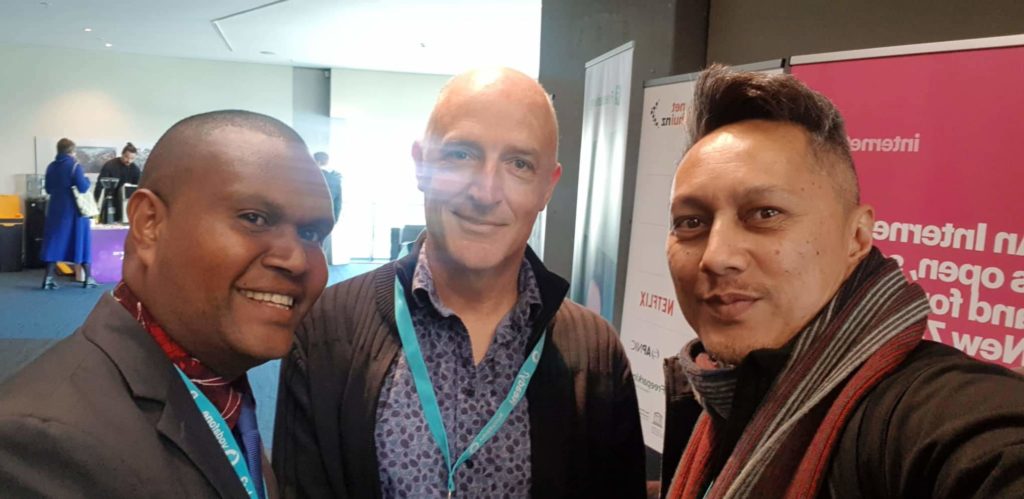
Two of our Board members Emani and Maureen were able to divert their schedules and attend NetHui in Wellington earlier in October.  It was exciting to see Jackson from Vanuatu as well as Save our ICANN Oceania rep.  Some of the other PICISOC members were from Australia and those from NZ.

Some of the sessions that we attended had discussions topics that are similar to what our island communities experience everyday. 

Data & Privacy in Small Communities focused on topics of Mental Health, Improving Child Wellbeing, Supporting Maori & Pasifika aspirations, Building a Productive Nation and Transforming the Economy.  It was an interesting discussion around how data was sourced or used and how the privacy is protected in small communities.  Especially in small island nations where it may not seem important to us but data is what big organisations, businesses, online platforms and governments increasingly gather and use.  Sometimes it is used with well meaning purposes but the outcome may not be aligned with our cultures, traditions, ethics, requirements, beliefs, environment, flora and fauna.
Rural Access was also at the forefront and this resonated with us from the Pacific.  Some of the issues revolved around accessibility of which the government's UFB (Ultra Fast Broadband) and RBI (Rural Broadband Initiative) continues to not cover the rest of rural and remote communities.  Some WISPs (Wireless ISPs) play a major role in connectivity for those remote regions but they also depend on funding or spectrum licensing in some cases.  Small operators in the ISP industry are hoping to test 5G.

Technology & Maori Community Wellbeing discussed advancements of technologies in Maori health, education, communications, transportation and other areas.  The facilitators are part of the Trust involved in the initial 2Degrees Mobile company setup.  It was the spectrum obtained by Maori that 2Degrees used.  As an observation, there is a disconnect between communities and those in the steering and leadership roles.  If one was in a Maori community that have accessibility issues to the internet, one would at the very least expect 2Degrees to have a part to play in facilitating the connectivity in either funding or delivery of the connection.  Some were disappointed and suggested a change with younger and vibrant forward thinkers.

We would like to acknowledge InternetNZ for the sponsorship and also grateful for Jonathan Brewer for beginning the discussion of having PICISOC at NetHui 2019.

October 25, 2019

NetHui is New Zealand’s version of IGF (Internet governance Forum).  It provides a platform for multi-stakeholders from various sectors to individuals to get involved in the discussion about “internet”, relevant to everyday community happenings.

Two of our Board members Emani and Maureen were able to divert their schedules and attend NetHui in Wellington earlier in October.  It was exciting to see Jackson from Vanuatu as well as Save our ICANN Oceania rep.  Some of the other PICISOC members were from Australia and those from NZ.

Some of the sessions that we attended had discussions topics that are similar to what our island communities experience everyday. 

Data & Privacy in Small Communities focused on topics of Mental Health, Improving Child Wellbeing, Supporting Maori & Pasifika aspirations, Building a Productive Nation and Transforming the Economy.  It was an interesting discussion around how data was sourced or used and how the privacy is protected in small communities.  Especially in small island nations where it may not seem important to us but data is what big organisations, businesses, online platforms and governments increasingly gather and use.  Sometimes it is used with well meaning purposes but the outcome may not be aligned with our cultures, traditions, ethics, requirements, beliefs, environment, flora and fauna.

Rural Access was also at the forefront and this resonated with us from the Pacific.  Some of the issues revolved around accessibility of which the government’s UFB (Ultra Fast Broadband) and RBI (Rural Broadband Initiative) continues to not cover the rest of rural and remote communities.  Some WISPs (Wireless ISPs) play a major role in connectivity for those remote regions but they also depend on funding or spectrum licensing in some cases.  Small operators in the ISP industry are hoping to test 5G.

Technology & Maori Community Wellbeing discussed advancements of technologies in Maori health, education, communications, transportation and other areas.  The facilitators are part of the Trust involved in the initial 2Degrees Mobile company setup.  It was the spectrum obtained by Maori that 2Degrees used.  As an observation, there is a disconnect between communities and those in the steering and leadership roles.  If one was in a Maori community that have accessibility issues to the internet, one would at the very least expect 2Degrees to have a part to play in facilitating the connectivity in either funding or delivery of the connection.  Some were disappointed and suggested a change with younger and vibrant forward thinkers.

We would like to acknowledge InternetNZ for the sponsorship and also grateful for Jonathan Brewer for beginning the discussion of having PICISOC at NetHui 2019.

October 17, 2019

As appears in ITU News site

John Tai is a citrus farmer, who also raises and sells pigs for a living. Gertrude Andreas runs a technical training institution and has her own farm and piggery. They live in Jiwaka, Papua New Guinea’s youngest province. Agriculture is one of the primary key sector in the economy of Papua New Guinea.

John and Gertrude are taking part in a pilot project on e-agriculture, which is changing the way farmers communicate, brand and market their products and overcome their day-to-day challenges. This pilot project follows the Government’s commitment to adopt a strategic approach to transform the agricultural sector through the integration of digital technologies.

The pilot project is based on the proposed national e-agriculture strategy and is run by Papua New Guinea Department of Agriculture & Livestock, the Department of Information, Technology, Innovation and Energy, the National Information & Communications Technology Authority (NICTA), and Jiwaka Provincial administration. The International Telecommunication Union (ITU) and the Food and Agriculture Organization (FAO) are proving support to the pilot project, which draws inspiration from the FAO-ITU e-Agriculture Strategy Guide developed in 2016.

Papua New Guinea aims to identify accessible and affordable technological solutions to boost productivity in the agricultural sector, and generate new opportunities for employment and income for rural communities. Jiwaka province is the site of the pilot project.

“The opportunities presented by the emerging technologies are crucial for a developing country like Papua New Guinea where majority of the population (80-90%) are dependent on subsistence agriculture,” says Ken Shimizu, Head of FAO PNG Country Office. “Through affordable and accessible e-solutions, farmers are saving time and money by accessing vital information, communicating and networking with other farmers. Papua New Guinea is better positioned to harness ICTs for agricultural transformation into the future.”

Over the years, John Tai has relied on traditional farming methods but has been yearning for new ways to boost the productivity of his business. He was among 20 farmers selected to participate in the “Agritech using ICTs” training program in 2018. During the training, farmers were given basic digital skills on how to use a smart phone, a laptop and how to access the internet. They were also trained on how to set up and use social media applications as a tool for information gathering and marketing; sending and receiving e-mails; using mobile applications to collect and store information and data about their farms. There was also a session on QR code generation and reading, brand building using traceability, packaging and collective branding.

John’s newly acquired digital skills came in handy as he could record images of the animals and send emails.

In recognition of the enthusiasm shown by farmers to adopt mobile technology, the provincial government provided 25 smart phones to the participants while the National Information & Communications Technology Authority (NICTA), and the FAO gave mobile top up cards. In addition, that national regulator plans to connect three pilot sites in Jiwaka Province with high-speed broadband internet connectivity under its Universal Access Services (UAS) project. This will allow farmers living within the vicinity of the pilot sites to have access to internet to gather agricultural information.

“Integrating ICTs into the agricultural sector in Papua New Guinea is a bold step towards addressing the challenges facing the agricultural sector and will play an important role in improving livelihoods,” says Charles Punaha, Chief Executive Officer, NICTA. “As a regulator we are fully supportive of this new approach with a view to contributing to the long-term economic and social development of Papua New Guinea”.

The e-agriculture pilot program is also exploring the possibility of introducing other innovative technologies, which farmers can use in addition to the basic digital skills they have acquired. The Australian Department of Communications and the Arts is supporting the use of Blockchain technology to help farmers collect and share data on pigs’ traceability. Switch Maven has developed a mobile application to help farmers record the history of animals including weight, growth patter, breed, feed, vaccinations etc. The availability of data will help buyers determine the quality of animals and assist farmers adopt good farming practices and to establish a brand for their products.

“The integration of the blockchain technology in traceability offers exciting opportunities in the digital landscape with greater transparency, enhanced security and increased confidence and integrity,” says Ken Shimizu.

The program expects to promote wider adoption of good practices in the province and enhance their market access and sales potential.

Fifteen pig farms in Papua New Guinea are currently using the mobile application to collect data on their animals. The blockchain technology is also being planned to be used in other value chains.

Gertrude Andreas and the youth in her area have gone one step further trailing the use of QR codes to brand their melons for sale to the supermarkets in Mt. Hagen, the provincial town of Western Highland Province (WHP). Using the QR code melon buyers can identify the name of the producer as well as track the production process. Gertrude hopes that this technology will help farmers generate better income and improve the quality of products from Jiwaka.

Switch Maven conducted a training of experts on blockchain technology in collaboration with ITU, FAO and NICTA. The main objective of the training was to equip local software developers with the necessary skills and knowledge in understanding and implementing the Blockchain technology.

Although the use of the Blockchain technology faces several challenges including lack of awareness on technology amongst farmers, Raman Nambiar from Switch Maven says the application has great potential in building trust in the pig farming value chain and hopes it can be scaled up to a fully-fledged e-market place.

The use of digital solutions to boost agricultural production in Jiwaka is generating a lot of enthusiasm amongst farmers and other stakeholders. The provincial government also recognizes the great potential of technology for other products, especially coffee, which is the main agricultural product from the province.

“This is the 21st century and the world is moving into technology. The e-Agriculture pilot project in Jiwaka provides an excellent opportunity for farmers to access vital agriculture and livestock information using ICTs,” says Steven Wusik, Acting Administrator for Jiwaka Provincial Government. “Our farmers can now connect with other farmers to get information, assistance and access to markets, which could be a very tedious process without technology. Under my leadership, I will accord full support to this pilot project to make it successful.”

The beautiful rural province of Jiwaka has now the opportunity to use digital technology to establish a brand for its products, improve livelihoods and become a model for adopting digital technologies for agriculture to transform lives.

This pilot project is in support of the ITU Asia Pacific Regional Initiative on harnessing information and communication technologies to support the digital economy and an inclusive digital society.

Original article: https://news.itu.int/digital-agriculture-transforms-farmers-lives-in-papua-new-guinea/

October 16, 2019

Blog by Joylyn Puairana – fellow APNIC 48

On Friday 28th June 2019, I came to work in the morning and was sitting in front of my working PC and suddenly saw this email from APNIC popped up. I opened and it said “ACCEPTED”. I was so excited and over the moon and said to myself, “yes I got it”. At first, i shared my exciting news with my working colleagues. After work I went home and shared with my partner. He was very helpful and encouraged me how and what to do during my travel.

Each year APNIC arranges two huge conferences – the first is held as a conference track of APRICOT and a second as a standalone conference. Each year, the APNIC community come together for policy development, education, information-sharing, decision-making and networking both professional and social.

I was very lucky to attend APNIC48 in Chiang Mai, Thailand (5 to 12 September 2019) as a fellow. I was the only fellow selected from Solomon Islands and joined with other professional fellows from Bhutan, Brazil, Bangladesh, Cambodia, China, France, Guam, India, Myanmar, Mongolia, Papua New Guinea, Sri Lanka, Thailand, Timo Leste, Tonga, Vanuatu and Vietnam. We combined in with the crowd of mixed cultures so nicely and are still in touch with each other.

APNIC 48

APNIC conferences are divided into two sessions. The first five days are for hands-on workshops and the last three days are for the conference. I received the fellowship for both the sessions. This is first time attending this APNIC event.

Gaining hands-on experience during the workshops

APNIC offered four workshop tracks during APNIC 48: Advanced BGP & ROV, Introduction to SDN, Network Security and IPv6 Development. I went for Network Security because of my role as core network engineer (Circuit/Packet Switch). I wanted to learn more and new things so that when I returned to my job, I could implement it.

The Net Sec workshop covered security fundamental, Threat pragmatic, crypto basic, Honeypots & Honey net , penetration testing, infrastructure security, RPKI, IDS & Suricata, DSN security etc. There were labs after each topic which were very helpful and they gave us more knowledge about the topics been thought. We came to know new security technologies and new schemes of securing our data that we didn’t even think of in our daily life.

Our instructors were highly skilled security experts who are working day and night to secure the Internet. Having the opportunity of interacting with them was so educating and profitable and they were very kind enough to share with us. Also have a great time to interacting with other fellows during the workshop. We are like family. I was already surprised with the workshop week but the conference week provided us with even greater value. For myself, i really learned a lot of new things during the Net Sec workshop.

Networking with the big and different people

This was my first ever international conference. On the first day of the conference, the entire lobby was crowded by the shining stars of the Internet industry. I don’t expect to see that kind of crowd.

There are so many big people whose groundbreaking hard work brought the Internet to this level gave valuable speeches on their chosen topics. The best part was after each session they mingled with each of us, listened to each of our interests and shared their contacts. 

In a small country like Solomon Island, we work, we eat and we go to bed. However, somewhere in a corner of this universe a bunch of people are working so hard, putting all their knowledge and energy to create a secure Internet. They are also looking for ways to transfer the knowledge to developing countries like us so that we can experience a better Internet and can develop our local community. I feel proud that I met them in person and received their attention. I can’t thank APNIC enough for this opportunity.

An opportunity of lifetime helps with getting ahead

Like APNIC, there are many other non-profit organizations that are there to assist us. They provide fellowship as well. We have so many resources available. We just need to look around and need to stretch our hands.

Before attending this conference I was so lost as a beginner. Information Security is a huge area and I didn’t know where to start from. Attending the workshop and conference didn’t make me an expert overnight, but it left a huge impact on me. It helped me to think in a different and better way.

This was also my ever first travel alone outside my country Solomon Islands. It is hard to describe in words that how special it was to me. I may get more fellowships in future but those will not be like this one. APNIC 48 is very close and special to my heart and the sweet memories with my fellows makes me emotional. It was learning with fun and also making and meeting new networks. 

Ten days we were away from our families. We laughed together, we helped each other and networking. We promised one thing that no matter where we are after this conference we will contribute to present a secure and better Internet to our next generation and will help to develop our local community.

Hopefully someday, at another conference, I will get to see those favorite fellowship faces again, to laugh and share, and to make new promises! 

October 14, 2019

BA, Management, Administration and GIS, USP, Fiji

Certificate in Telecommunications, Telekom College, PNG

Project Manager, BRANTV UNDP/GEF Project, Department of Energy, Ministry of Climate Change

Chairlady Women in ICT – Vanuatu
Email: doreenleona16@gmail.com; dleona@vanuatu.gov.vu
Facebook accounts: Women in ICT – Vanuatu

Doreen Leona graduated with a Bachelor of Arts in Geographical Information Systems (GIS), Management and Administration at the University of South Pacific (USP) Suva Fiji in 1998.

She started working as a Mapping officer for the Policy and Planning, Ministry of Education. A year later she joined a local telecom company Telecom Vanuatu Limited (TVL) introducing GIS as a tool to design underground networks for both copper and fiber networks. The tool was also used to map Radio networks and mobile coverage. She finished working for TVL as a Sales Customer Care and Distribution Manager and joined Telecommunications and Radiocommunications Regulator (TRR) as a consultant in GIS and ICT Special projects.

One of the projects was launched the first ever ICT Days in Vanuatu in 2012 with the theme Women and Girls in ICT. The GIS database was implemented and a training guide was developed.

She left TRR to join the Vanuatu National Provident Fund (VNPF) when she was managing the Broadband pilot project on the Universal Access Policy at Rensarie college, Malekula.

Since December 2018 she was recruited as a Project Manager on UNDP/GEF Energy project, BRANTV to mitigate Climate Change and achieve the National Energy Road Map (NERM) targets of Vanuatu.

She started the Women and Girls in ICT for Vanuatu launched the Association and its constitution in 2015. Every year Vanuatu joined the international communities to celebrate Women and Girls in ICT Day every fourth Thursday of the fourth week of April.

She is also a member of the SMART Sistas group, promoting and empowering girls in ICT through coding and programming. We have SMART Sistas girls ICT camp every year during the ICT Days in May.

CORE COMPETENCIES

  • Over seven years Designing Underground (copper & fiber) Telecommunication Network
  • Seven  years managing Telecommunications Technical Department
  • Four years managing Telecommunication’s Commercial Department
  • Community Development Project experience in Telecommunications
  • Design and Build GIS Database for Telecommunications Industry
  • Chairlady Women and Girls in ICT Vanuatu
  • ICT Advisor
  • Project Design and Management
  • Effective Report Writing
  • Quality Events Organization
  • Multiskilling
  • People’s Relation Skills
  • Fluency in English and Bislama  

ACHIEVEMENTS

  • Build GIS for Telecommunications industry
  • Computerize Telecommunications Underground Network Designs
  • Coordination of the First National ICT Day World Telecommunications
  • Participate in the development of the first national ICT and UAP Policies
  • Launch of National Women and Girls in ICT organizations
  • Successfully Manage UAP Broadband Pilot Project in a Community Centre in Rensarie Malekula
  • Participate in the development of the Corporate Strategic Plan
  • Participate in Coordinating the ICT Strategic Plan

October 14, 2019

Women in IT Solomon Islands

A brief background of WITSI:
WITSI was formed in 2017 after a group of young female ICT professionals attended the 2nd Annual Women in Tech Conference in Sydney, Australia and returned to Solomon Islands inspired to come together to address challenges facing females working in ICT and to promote Information and Communication Technologies (ICT) careers amongst women and girls in Solomon Islands.

The WITSI founders realized the shortage of skilled ICT professionals and university graduates in the country as well as the underrepresentation of Solomon Islands females in the ICT workforce. The group currently has 49 members and comprises of female IT professionals in both the public and private sector including students currently pursuing IT studies. It has an Interim Executive Committee that consists of 9 members who meet on a voluntary basis when the need arises.

WITSI is an affiliate of a larger and legally registered IT body – the Information Technology of Society Solomon Islands (ITSSI) and strives to help ITSSI achieve its strategic key goals and objectives. Since 2018, WITSI has endeavoured to promote ICT as a career for young girls in Solomon Islands and have already begun ICT awareness talks in several schools.

Recent Key Achievement:

One of WITSI’s recent key achievement/stories which we wanted to share with PICISOC is the ITU Girls in ICT Day annual event which WITSI organizes and host each year. This annual event provides WITSI with an opportunity to advocate and promote public ICT literacy to our primary and senior female students in Solomon Islands to kindle interest for ICT at a very young age as well as to maintain our relationship and partnership with stakeholders to develop and advance ICT amongst our women and girls in Solomon Islands. Please find attached our 2019 Girls in ICT Day Report for detailed activity highlights. The report was specifically targeted towards our event sponsors however we are happy to share this with you in our quest to ‘Expand Horizons and Change Attitudes’.

Resources:

WITSI Brochure

WITSI Facebook page, follow to keep abreast with other WITSI events and stories: https://www.facebook.com/WomenInITSolomonIslands/

For other ITSSI events/stories from IT Society Solomon Islands webpage: https://www.itssi.sb/

October 14, 2019

(Embargoed until 6:00 p.m. Friday 11 October 2019)

The recently established Samoa Information Technology Association (SITA) held its launch as a professional society of ICT Professionals today at TATTE Convention Centre. The President of SITA, Mr. James Ah Wai, introduced the keynote speaker, the Hon. Tuilaepa Lupesolia’i Sa’ilele Malielegaoi, Prime Minister. Other invited guests included members of the Diplomatic Corp., government officials, members of the business community and civil society.

SITA will provide a platform for IT professionals and its related disciplines in Samoa. The Association aims to foster education and capacity building, set professional standards, promote research and development, strengthen national and international networks for its membership and provide advice to government on ICT issues.

Mr. Ah Wai stated that “Our Samoa Information Technology Association or SITA have come to existence because we believe in our vision that Technology is for Everyone.” In this regard it is hoped that SITA will be an active body in the community and will collaborate with the public, and private sectors as well as interested development partners to implement as many projects as possible for the benefit of Samoans.

SITA’s 7 main objectives are;

  1. To develop the practice of the profession of information technology and related disciplines in Samoa.
  2. To foster the training, education and qualification of those practicing or intending to practice the ICT profession in Samoa.
  3. To promote proper conduct within its membership and to set ethical standards for the profession.
  4. To develop or provide lectures, meetings, conferences and to promote research in information processing and computer technology.
  5. To promote any other related activities that is in the interests of the Association and its members
  6. To have a voice to the Government and its people on all issues pertaining to ICT
  7. To encourage collaboration and networking with local Businesses, Regional and Funding Organisations for the development and Implementation of ICT projects for the betterment of community.

SITA also officially launched its new website www.sita.ws. The website allows followers to keep updated of the latest news and developments of ICT projects happening in Samoa and the region.

Over one hundred ICT professionals from Samoa have registered their interest to join SITA. Each new applicant will be assessed and assigned to various memberships depending on the level of experience and or qualifications.

SITA takes this opportunity to thank all its partners and sponsors for their generous support and advice leading up to the launch, including but not limited to; Hon. Afamasaga Rico Tupa’i Minister of Communications and Information Technology, Fualau Talatalaga Mata’u Matafeao, Chief Executive Officer, MCIT, Bluesky Samoa, Digicel Samoa, Samoa Commercial Bank, Taula Beverages, National University of Samoa, Office of the Electoral Commission, Skyeye, Greenology Consult Samoa and Pacific Technologies.

Read the story as published by Samoa Observer: https://www.samoaobserver.ws/category/samoa/51227?fbclid=IwAR3tmqSh-F1LCvD9yNmkGbU_9Ec2MKzfP7zpWZQJFT4lGI_qsCpSZRP6HlI

  • « Go to Previous Page
  • Page 1
  • Interim pages omitted …
  • Page 21
  • Page 22
  • Page 23
  • Page 24
  • Page 25
  • Interim pages omitted …
  • Page 38
  • Go to Next Page »

Footer


Physical Address
of the Chapter
+1-111-111-111

© 2026 Internet Society Chapter

Copyright © 2026 · Internet Chapters on Genesis Framework · WordPress · Log in

  • Home
  • About Us
  • Board Business
  • Events
  • SIGs