
• Skip to primary navigation
  • Skip to main content
  • Skip to footer
Picisoclogo

PICISOC.niue.nu

The Internet Society in the Pacific

Search

Search DropdownSearch Icon Join
  • Home
  • About Us
    • What is PICISOC?
    • History of PICISOC
    • PICISOC Members
    • Code of Conduct
    • PICISOC Netiquette Guidelines
  • Board Business
    • Current PICISOC Board Members
  • Events
    • PacIGF 2023
    • Pacific Internet Governance Forum (PacIGF)
    • PacINET
    • International IGF Reports
    • ICANN Meeting Reports
    • Pacific Regional Meeting Reports
  • SIGs
    • Research and Development Partners
    • Pacific Islands Education
    • Pacific Islands FOSS
    • Pacific Islands GIS/RS
    • Pacific Islands Internet Freedom

The ICT twist with COVID-19

The ICT twist with COVID-19

The Kingdom of Tonga, along with neighbouring Pacific Island countries, are dealing with the impacts caused by the COVID-19 global pandemic. Every sector has been affected including IT. The Government of Tonga is struggling to protect the health and well-being of citizens while providing a stable and safe environment for its citizens as the pandemic worsens overseas.

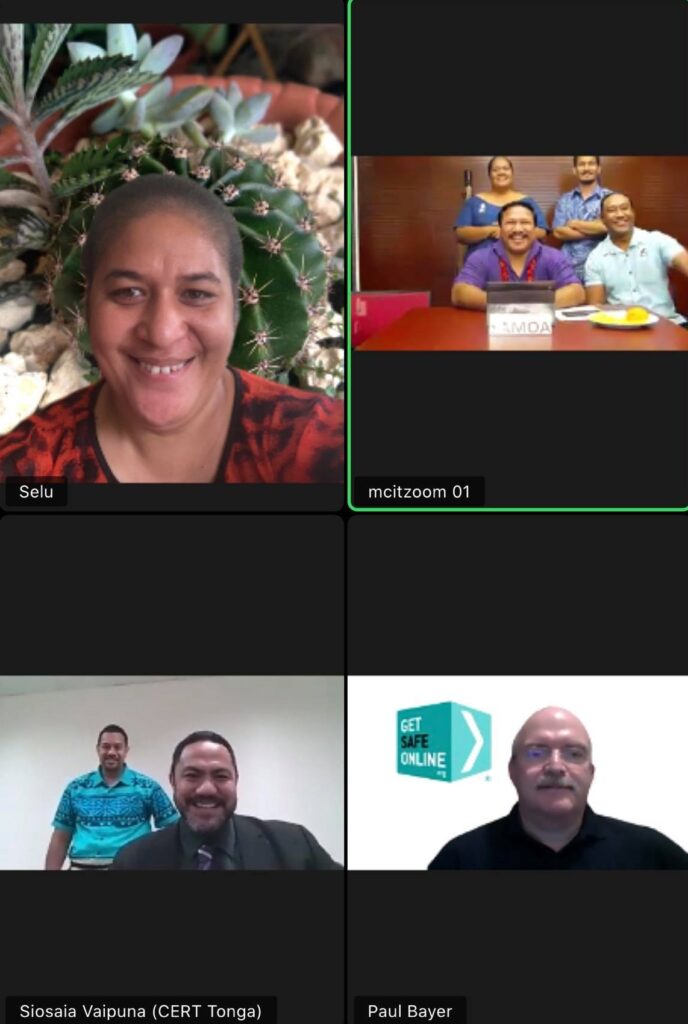
Though Tonga is COVID-FREE, it is preparing for the outbreak reaching its shores. Tonga carried out a national lock-down period in May 2020, where its workforce both in the public and private sector were required to work from home. Schools were also closed and students were required to remain at home and study. Since then, Government has made efforts to increase readiness with regards to working and learning from home for any future lock-downs. The Ministry of Education has put in place an online learning platform for all schools and has carried out multiple trials with much success. Government ministries and businesses have also put in place technologies and IT resources to help relevant staff work from. VPNs and video conferencing platforms such as Zoom have grown popular especially with those in corporate and executive circles. Zoom is being used for trainings and meetings despite using both paid and free subscriptions. There is a growing need for proper training in order to use these technologies safely and effectively.

But not everyone was able to accommodate for remote work. Some were unable due to the nature of their work as well as other factors such as (i) Accessibility concerns; (ii) Security challenges and (iii) outdated policies and regulations that recognizes working remotely as an acceptable mode of work. Other issues include staff struggling to balance work and home obligations having to deal with distractions and responsibilities at home.        

With more and more people working from home, Cybersecurity risks are likely to increase. Data theft and fraud are then more likely to happen in this environment. Existing challenges in using IT resources within each organisation, will surely make things difficult for IT administrators and technicians in a more remote-working environment. These existing challenges include users using simple passwords, sharing their work laptops and their login credentials with their family members so that they use it for personal use.

The spread of this deadly virus has caused a lot of regional and international conferences to be cancelled or moved online. These conferences have provided many partnership opportunities to strengthen and build capacity especially those in the Pacific Islands. They provide as networking and collaborative opportunities. While virtual meetings provide a solution during the pandemic, it has limitations and it inhibits the ability to truly interact and connect with partners and colleagues from other countries.

Aside from work settings, there is a rapid increase in the use of social media and video call platforms such as Google Hangouts, WhatsApp Video call, Skype and Facebook messenger by the general public. More than ever, these platforms help people stay connected especially those who are in quarantine, isolation as well as those stranded overseas due to border closures. Social media, teleconferencing, working from home, education from home, selling and buying online, are some concepts that are not new to Tongans, however, they have become more apparent and critical as a result of this pandemic. As a result there is a need to strengthen IT resources, capacity building and cybersecurity in order to provide a stable, secure environment for its citizens.

Author: Seluvaia Kauvaka , October 2020.
Chairlady - Tonga Women in ICT (TWiICT)

October 19, 2020

The Kingdom of Tonga, along with neighbouring Pacific Island countries, are dealing with the impacts caused by the COVID-19 global pandemic. Every sector has been affected including IT. The Government of Tonga is struggling to protect the health and well-being of citizens while providing a stable and safe environment for its citizens as the pandemic worsens overseas.

Though Tonga is COVID-FREE, it is preparing for the outbreak reaching its shores. Tonga carried out a national lock-down period in May 2020, where its workforce both in the public and private sector were required to work from home. Schools were also closed and students were required to remain at home and study. Since then, Government has made efforts to increase readiness with regards to working and learning from home for any future lock-downs. The Ministry of Education has put in place an online learning platform for all schools and has carried out multiple trials with much success. Government ministries and businesses have also put in place technologies and IT resources to help relevant staff work from. VPNs and video conferencing platforms such as Zoom have grown popular especially with those in corporate and executive circles. Zoom is being used for trainings and meetings despite using both paid and free subscriptions. There is a growing need for proper training in order to use these technologies safely and effectively.

But not everyone was able to accommodate for remote work. Some were unable due to the nature of their work as well as other factors such as (i) Accessibility concerns; (ii) Security challenges and (iii) outdated policies and regulations that recognizes working remotely as an acceptable mode of work. Other issues include staff struggling to balance work and home obligations having to deal with distractions and responsibilities at home.        

With more and more people working from home, Cybersecurity risks are likely to increase. Data theft and fraud are then more likely to happen in this environment. Existing challenges in using IT resources within each organisation, will surely make things difficult for IT administrators and technicians in a more remote-working environment. These existing challenges include users using simple passwords, sharing their work laptops and their login credentials with their family members so that they use it for personal use.

The spread of this deadly virus has caused a lot of regional and international conferences to be cancelled or moved online. These conferences have provided many partnership opportunities to strengthen and build capacity especially those in the Pacific Islands. They provide as networking and collaborative opportunities. While virtual meetings provide a solution during the pandemic, it has limitations and it inhibits the ability to truly interact and connect with partners and colleagues from other countries.

Aside from work settings, there is a rapid increase in the use of social media and video call platforms such as Google Hangouts, WhatsApp Video call, Skype and Facebook messenger by the general public. More than ever, these platforms help people stay connected especially those who are in quarantine, isolation as well as those stranded overseas due to border closures. Social media, teleconferencing, working from home, education from home, selling and buying online, are some concepts that are not new to Tongans, however, they have become more apparent and critical as a result of this pandemic. As a result there is a need to strengthen IT resources, capacity building and cybersecurity in order to provide a stable, secure environment for its citizens.

Author: Seluvaia Kauvaka , October 2020.
Chairlady – Tonga Women in ICT (TWiICT)
October 14, 2020

A pdf booklet which explains what is happening policy wise for each of the ICANN sections that will be covered during ICANN69

Click to view this document

October 14, 2020

Yesterday, October 11 was the international day of the girl and so let’s celebrate one of our own, Ms. Georgina Hilei’i Kiele who hails from Manus and New Ireland province in Papua New Guinea. She is working to bring up her younger sister and be a role model for her and teach her how to be strong, effective, and empower her to succeed and grow. So on this #InternationalDayoftheGirl let’s celebrate the power of girls and lift up their voices. 

  • Georgina Hilei’l Kiele

Georgina started her career in the ICT sector as a PC Support Analyst with Steamships Group of Companies in their Computer Services division before joining the Department of ICT within the PNG Government.  Little did she know that she would one day be part of a team ensuring that all Government data are kept safe, secure, and accessible when needed as well as ensuring that valid information on a pandemic is uploaded promptly for the benefit of those who have access to the Internet in the country.

When asked whether she has always dreamed of working in the ICT space, Georgina replied saying, “No, I had bigger dreams. I wanted to become a pilot when I was in high school”. However, like most graduates, she wanted to be able to find a job after she graduated and realized that IT was an essential part of most organizations and that having an IT background would mean that she would always have a job. 

She then took up Information Technology at the University of Southern Cross through the Institute of Business Studies where she obtained her Degree in IT. 

Georgina works for the Department of Information and Communications Technology as the Cyber Services Team Leader within the Government of PNG. With the establishment of the National Control Center, Georgina also plays an important role as the COVID-19 Website Administrator. 

Her role within the NCC is important as she is responsible for uploading and updating the contents of the COVID-19 website so that we all (those who have access to internet) to have access to the latest new surrounding COVID-19 in PNG.

For Georgina, marriage life is not in the near future. She is the proud guardian of her younger sister who is 17 years old and is doing grade 9 at St Charles Luwaga Secondary school. She definitely knows how to balance work and helping her younger sister with her homework and assignments, whenever she can. 

She jokingly said, “Nowadays, the internet seems to make research easier” which gives her some time to relax.When asked what she likes about her role with NCC, she responded;  “I like my job because I realized how important it is to disseminate information to our people. 

“Because of so much fake news on social media, the website has become the base of real news in regards to COVID-19 in PNG. “With the recent spike on the number of positive COVID-19 cases , the website has had over 5000 visitors in one day and over 400 000 visits since it was created. 

“It is my duty to upload content and ensure the very important notices, advisories, and documents such as the Pandemic measures are placed in a way that they are accessible and visible”. 

For this role,  Georgina works after her normal working hours, only if content is ready and approved for uploading on the website. 
Georgina plays different roles in different sections within the DICT by providing support to them apart from her daily role as the Team Leader – Cyber Services. 

She works closely with the Deputy Secretary – Ms. Alangit who provides and approves content/ information that needs to be uploaded on the COVID-19 national website. She also provides support to IGIS (Integrated Government Information System) on a needs basis where the Help Desk is a female. However, at the National Cyber Security Centre, 

Georgina is the only female working with two male colleagues who are based in Australia due to the Covid-19 restrictions. She works from Monday to Friday, 8am to 5pm. And if needed, she works overtime and on weekends too. She has earned the respect from her male colleagues and has developed good working relationships with her male colleagues. 

For her role in NCSC, she does the physical technical work while been guided by her colleagues who are still in Australia. Three of her memorable achievements are;

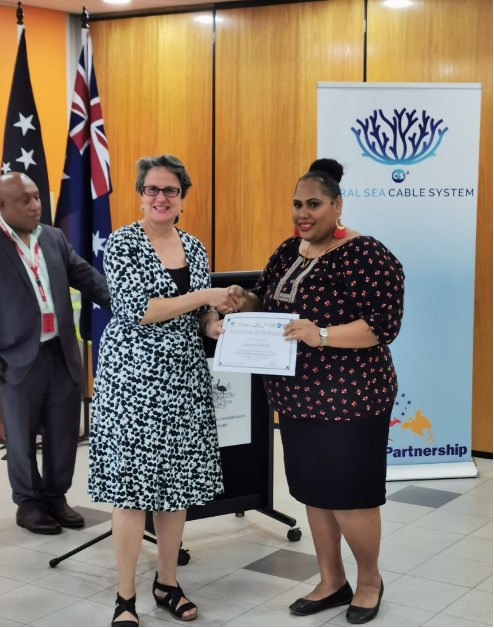
i. She received a Certificate of Dedication as a Coral Sea Cable System Repeater R1101 being named after her in December 2019.

ii. She was also part of the Cyber Security Team at NCSC during APEC meeting

iii. She received a Certificate of Appreciation from the PM in recognition for being part of the COVID-19 JATF NOC19 Team from March 23rd to June 16th 2020.

“It’s an honor to be able to serve my country and I thank God who has enabled me to do this work and I hope stories like mine inspires more girls to take up ICT-related career paths” Georgina says.

October 14, 2020

The University of Fiji, in collaboration with Missions Publiques, hosted the Global Citizen Dialogue on the Future of the Internet with the theme “We, The Internet”.

Speaking at the workshop, the Acting Vice-Chancellor, Professor Shaista Shameem, said that the dialogue could not have come at a more opportune time.

“Covid-19 has forced us all to go almost exclusively online for everything – work, study, communication, trade and exchange, and entertainment,” she said.

She noted that the heartening part of such a Dialogue was that it came with the oversight of the United Nations. The results of the workshop will be delivered to the United Nations Secretary General through the UN High-Level Panel on Digital Cooperation.

She also said that the internet had transformed from being a tool of efficiency to an indispensable vehicle of life in the 21st century.

“At this University, we are perfecting learning platforms daily by finding imaginative and creative ways of delivering lessons online. The most important aspect of this – and that creates transformation in education unprecedented in the past – is that we are not likely to go back to what used to be, because our teaching and learning has suddenly and unexpectedly improved and has created its own market and following among the staff and students,” she said.

Furthermore, she stated that with online teaching of a particular quality, the University was able to emulate actual physical classroom. This methodology is called “Face to Face Online”.

“We can now offer our programmes internationally without students having to leave their countries; and our working students are finding it easier to attend classes when they do not have to leave their desks and rush to physical lecture rooms, usually arriving late due to traffic,” she said.

Professor Anirudh Singh, Dean of the School of Science and Technology, said that more than 100 participants from all walks of life participated in the Dialogue.

“The Dialogue was to create awareness about the internet; what it is and what it is capable of doing. It is really important to have dialogues like this because it helps people learn about the true capabilities of the Internet,” he said.

Mr. Inoke Sarava, from Ba, said that he was glad to have attended the Dialogue.

“The whole concept about digital and online is an urban language for me. To come here and be enlightened, I see how far I have been left behind. I have experienced and gathered so much today, in a short amount of time and now I want to go deeper,” he said.

Ms. Sikiti Toga, from Lami, Suva, said that she learned the risks associated with data sharing and the pros and cons of using the internet and much more from the Dialogue.

The Global Citizen Dialogue on the Future of the Internet is part of a phase of global citizen deliberation and participatory democracy, the goal of which is to allow citizens to express their voices on the Internet’s future.

Citizens’ recommendations at the Dialogue will be presented to local and regional governments as well to the Internet Governance Forum 2020 under the theme “Internet United.”

Source: Fiji TV

October 14, 2020

Having an open, secure, stable, accessible and peaceful cyberspace is vital for development.

 This message was conveyed at the opening of the Global Citizens Dialogue at the University of Fiji yesterday by the Acting Permanent Secretary for Communications and Director-General Digital Government Transformation, Cybersecurity and Communications Ms Tupou’tuah Baravilala to the 125 participants.

 Today, 95% of all Fijians have access to internet connectivity and coupled with call charges, text and broadband rates being at the lowest prices that we have ever seen, at the highest speeds we’ve ever seen, it is clear that the internet has now become an integral part of our lives.

 “This brings about many benefits however it does have its challenges and risks. If these challenges are not managed, it can undermine the realisation of the full benefits of the internet. This requires a collective effort,” said Ms Baravilala.

 Amongst the Government’s existing efforts to maintain a safe and secure cyber landscape, Ms Baravilala stated that the Cybercrime Bill which has been tabled in Parliament is aligned to the Budapest Convention – the only binding international instrument to address internet and computer crimes.

 “As responsible digital citizens, we must stay vigilant against misinformation, disinformation and fake news, refer to official and reliable sources and be mindful of the type of personal information we share online,” stressed Ms Baravilala.

 She also encouraged participants to visit the website of the Online Safety Commission to get more information on cyber hygiene and how to be protected online.

 “The Fijian Government’s mandate as highlighted in the 5 Year and 20 Year National Development Plan is to provide universal access to information and competitive telecommunication services delivered on a secure platform,” she said.

 Ms Baravilala explained Government’s multifaceted and holistic approach in progressively realising its mandate in the ICT space and encouraged participants to explore the e-Government services under the digitalFIJI initiative such as the e-birth registration and Registrar of Companies services and that these are available on the digitalFIJI app.

 Ms Baravilala also re-emphasised the role of digital tools during this COVID-19 period and the need to download the careFIJI app and to keep our phone Bluetooth turned on. This, coupled with other national health measures, will ensure that Fiji remains COVID-Contained.

 With the theme ‘We the internet’, the Global Citizens Dialogue aims to engage citizens from all walks of life in one of the most pressing and significant issues of our time, and Fiji is the first country out of the more than 70 countries in the world to deliberate on the issue.

Source: https://fijisun.com.fj/2020/10/05/government-pushes-lift-in-internet-connectivity/

September 30, 2020

Anne Dunn-Baleilevuka

Commissioner for the Online Safety Commission or OSC, Anne is an executive leader of Fiji’s recently established Online Safety Commission or OSC. The OSC Fijians a space to resolve concerns and complaints with respect to online abuse such as cyberbullying and promote online safety for all Fijians. With a passion for collaboration Mrs Baleilevuka seeks to promote cyber safety in a cohesive and inclusive manner while maintaining respectful boundaries. With interests that lie beyond the digital realm, Anne is also an avid participant in youth empowerment especially of young women around the country.

  • « Go to Previous Page
  • Page 1
  • Interim pages omitted …
  • Page 9
  • Page 10
  • Page 11
  • Page 12
  • Page 13
  • Interim pages omitted …
  • Page 38
  • Go to Next Page »

Footer


Physical Address
of the Chapter
+1-111-111-111

© 2026 Internet Society Chapter

Copyright © 2026 · Internet Chapters on Genesis Framework · WordPress · Log in

  • Home
  • About Us
  • Board Business
  • Events
  • SIGs