• Skip to primary navigation
  • Skip to main content
  • Skip to footer
Picisoclogo

PICISOC.niue.nu

The Internet Society in the Pacific

Search

Search DropdownSearch Icon Join
  • Home
  • About Us
    • What is PICISOC?
    • History of PICISOC
    • PICISOC Members
    • Code of Conduct
    • PICISOC Netiquette Guidelines
  • Board Business
    • Current PICISOC Board Members
  • Events
    • PacIGF 2023
    • Pacific Internet Governance Forum (PacIGF)
    • PacINET
    • International IGF Reports
    • ICANN Meeting Reports
    • Pacific Regional Meeting Reports
  • SIGs
    • Research and Development Partners
    • Pacific Islands Education
    • Pacific Islands FOSS
    • Pacific Islands GIS/RS
    • Pacific Islands Internet Freedom

The Pacific Islands e-Learning Talanoa

The Pacific Islands e-Learning Talanoa

The Pacific Islands e-Learning Talanoa was organised by the PICISOC Education Working Group and drew on the experiences of four regional e-Learning leaders with more than a total of 50 years of combined e-Learning or ICT for Better Education experience.

It was scheduled for 7PM on Thursday 20th November, with some confusion on the actual time due to daylight saving issues.

The aim of the Talanoa was to share e-Learning (or ICT4Better Education) experiences, issues, good practice and lessons learned from some 15 years of initiatives in the region and to see how these can inform current plans.

Presentations

The following is a summary of the key issues and lessons learned from each of the presenters.

Gail Townsend

Gail spoke about the Distance Learning project in the Cook Islands, providing qualified teachers support via the internet to remote island students that do not have qualified teachers.

Gail commented that in hindsight, they really didn’t fully understand what it was all about (they didn’t know what they didn’t know) and that they didn’t really know if the hardware and software  was appropriate and if the teachers, students and parents were ready. The program really relied on a few passionate teachers and technical staff. But they had a great idea and a willingness to make it work and they learnt as they went along. As one example, providing redundant equipment in case the item breaks was not thought about initially, but it was added in the second year.

Four key issues were identified:

  • Student readiness (for self-managed learning) was unknown
  • School principals and teachers understanding, and readiness for e-Learning was unknown
  • Parents understanding and expectations was unknown
  • Good communications are critical to work through these unknowns

Overall, the education system was not really ready for e-Learning.

A key lesson learned is that students needed additional in classroom help/supervision for this kind of learning and additional local Teachers Assistants had to be found and trained.

One unintended outcome was that when e-Learning students came to the main island for secondary schooling the following year, they found it much easier to assimilate, already knowing other students and teachers virtually.

Artila Devi

Artila is the Education lead in the Catalpa run e-Learning for Science in the Pacific program in four Islands. The program addresses devices, contextualised digital content, and teacher professional development. It is based on the belief that the digital device compliments the teacher and does not replace them and at the core of the project are three elements of a) Context, b) scalability and c) sustainability. Key elements will be the development of contextually appropriate digital science resources that link to the curriculum and embedding e-Learning within the current community social context.

It is in its early days and efforts are being made to engage all people and organisations that have an interest in education, not just teachers and students.

Key elements for success have been identified as:

  • Involving and sharing with the whole community that is interested in education
  • Design for scalability to allow MOEs to build on the program over time
  • Design for sustainability through long term planning, not just for the term of the project
  • Developing partnerships e.g. with USP and SPC

She commented that advances in the ICT sector such as most teachers having smart phones and connectivity becoming cheaper and more available are making the project much easier.

Siaosi Sovelini

The honourable Minister from Tonga, who is well known to PICISOC members as a long-term champion of ICTs, discussed the project of ensuring learning can continue if schools in Tonga are closed for extended periods, e.g. for a COVID 19 lockdown. The key element was ensuring learning from home with technology could be successful. He commented that the urgency of COVID 19 really forced MOEs to rapidly advance e-Learning which had previously been something they thought they would get around to later.

As not all students had access to the internet, so a multi-media approach was developed involving radio, TV, internet, and paper. Content was locally developed for all media.

An early trial was conducted, and a survey of teachers, parents and students carried out and changes made to accommodate feedback. Interestingly, the most common comment was that now people appreciated how much work teachers do to teach their children. The survey was quite an eye opener to MOE staff.

Finally, a national trial was conducted to ensure all schools could be covered.

Lessoned learned are:

  • Informing and supporting parents is critical for home learning
  • Education in the outer islands has improved (an unexpected bonus) and parents developed a better appreciation of teaching and what teachers do
  • Primary school students prefer radio while secondary prefer TV and internet
  • Training in cyber safety is important

The honourable Minister concluded by saying they are still learning a lot about home learning and they are developing better ways to help students learn and they are investigating special education internet packages with the internet provider. He further commented that being forced to do this by COVID was a key driver for their success.

Alapati Taupo

Alapati is the senior Education Officer for ICT in Tuvalu and has been running the E-learning School System to provide access to more digital learning resources for all primary students. Because of the limited availability of the internet in outer islands, the system was designed from the ground up as off-line and power was provided if not available.

OERs (e.g. RACHEL) are stored in redundant servers and portable devices such as Kio Kits and access is through computer labs and tablets. Alapati mentioned some key challenges as being the amount of red tape (the system is not well suited to e-Learning, especially in financing/budgeting), getting school ownership, e-Learning not being a priority on some islands and alignment or adaption of the OERs to the curriculum. They are now working on aligning the content with the curriculum and contextualising it. He commented that considering the remoteness of the outer islands, equipment redundancy was built in the original design

Key success factors include

  • Support from top to bottom is essential (cabinet to teaching staff, island councils, donors and partners) to undertake e-Learning
  • Capability must be available to deploy and support the technology (with redundancy built in to cater for equipment failure) on remote islands
  • Getting school buy in and ownership of the system in key and takes time
  • Must carry out Measurement and Evaluation to allow the system to develop

Alapati stressed that e-Learning will never substitute face to face teaching and concluded by saying “It is a marathon, needing 3-5 years sustained effort” and it must be driven by a vision. Initially he thought it was all about getting the hardware and resources to the schools and completing the teacher training, but the reality is that there will be lots of failures and hurdles to treat as learning experiences to adapt to and develop better solutions.

Some common themes and issues

The following themes and issues were drawn from the presentations, questions, and chat messages

  1. e-Learning is a (continuous) learning process. Providing the hardware, software and content is only the beginning.
  2. We must allow for “failures” and unexpected adaptations, meaning projects and programs must be flexible.
  3. Our approaches must be more inclusive and consider the wider elements and priorities around education
  4. There seems to be many reasons for, and expectations of, implementing e-Learning/ICT4BE and the vision and outcomes must be clearly stated and understood and M&E must be included to clearly demonstrate benefits.
  5. Planning up front for sustainability and scalability is important. (We have had enough standalone pilots and trials)
  6. COVID 19 seems to have increased the priority of implementing e-Learning and we should capitalise on this (also to help other national emergencies effecting education)
  7. There is good potential for learning from each other
Additional resources

Based on the presentations and issues raised above, the following resources could be useful:

  1. The Principles for Digital Development (including sustainability and scalability) https://digitalprinciples.org/principles/
  2. The Pacific Education Cluster Learning Continuity Mapping exercise. https://public.tableau.com/profile/mindfultime#!/vizhome/TestLCM/PECLearningContinuityMapping
  3. The most recent independent evaluation of learning outcomes from e-Learning in the Islands is perhaps the Kiribati Tablet Trial 2019 report by the University of Chicago. The Snapshot report is attached FYI.

Click to view the Kiribati Tablet Trial - A Snapshot Report

December 10, 2020

The Pacific Islands e-Learning Talanoa was organised by the PICISOC Education Working Group and drew on the experiences of four regional e-Learning leaders with more than a total of 50 years of combined e-Learning or ICT for Better Education experience.

It was scheduled for 7PM on Thursday 20th November, with some confusion on the actual time due to daylight saving issues.

The aim of the Talanoa was to share e-Learning (or ICT4Better Education) experiences, issues, good practice and lessons learned from some 15 years of initiatives in the region and to see how these can inform current plans.

Presentations

The following is a summary of the key issues and lessons learned from each of the presenters.

Gail Townsend

Gail spoke about the Distance Learning project in the Cook Islands, providing qualified teachers support via the internet to remote island students that do not have qualified teachers.

Gail commented that in hindsight, they really didn’t fully understand what it was all about (they didn’t know what they didn’t know) and that they didn’t really know if the hardware and software  was appropriate and if the teachers, students and parents were ready. The program really relied on a few passionate teachers and technical staff. But they had a great idea and a willingness to make it work and they learnt as they went along. As one example, providing redundant equipment in case the item breaks was not thought about initially, but it was added in the second year.

Four key issues were identified:

  • Student readiness (for self-managed learning) was unknown
  • School principals and teachers understanding, and readiness for e-Learning was unknown
  • Parents understanding and expectations was unknown
  • Good communications are critical to work through these unknowns

Overall, the education system was not really ready for e-Learning.

A key lesson learned is that students needed additional in classroom help/supervision for this kind of learning and additional local Teachers Assistants had to be found and trained.

One unintended outcome was that when e-Learning students came to the main island for secondary schooling the following year, they found it much easier to assimilate, already knowing other students and teachers virtually.

Artila Devi

Artila is the Education lead in the Catalpa run e-Learning for Science in the Pacific program in four Islands. The program addresses devices, contextualised digital content, and teacher professional development. It is based on the belief that the digital device compliments the teacher and does not replace them and at the core of the project are three elements of a) Context, b) scalability and c) sustainability. Key elements will be the development of contextually appropriate digital science resources that link to the curriculum and embedding e-Learning within the current community social context.

It is in its early days and efforts are being made to engage all people and organisations that have an interest in education, not just teachers and students.

Key elements for success have been identified as:

  • Involving and sharing with the whole community that is interested in education
  • Design for scalability to allow MOEs to build on the program over time
  • Design for sustainability through long term planning, not just for the term of the project
  • Developing partnerships e.g. with USP and SPC

She commented that advances in the ICT sector such as most teachers having smart phones and connectivity becoming cheaper and more available are making the project much easier.

Siaosi Sovelini

The honourable Minister from Tonga, who is well known to PICISOC members as a long-term champion of ICTs, discussed the project of ensuring learning can continue if schools in Tonga are closed for extended periods, e.g. for a COVID 19 lockdown. The key element was ensuring learning from home with technology could be successful. He commented that the urgency of COVID 19 really forced MOEs to rapidly advance e-Learning which had previously been something they thought they would get around to later.

As not all students had access to the internet, so a multi-media approach was developed involving radio, TV, internet, and paper. Content was locally developed for all media.

An early trial was conducted, and a survey of teachers, parents and students carried out and changes made to accommodate feedback. Interestingly, the most common comment was that now people appreciated how much work teachers do to teach their children. The survey was quite an eye opener to MOE staff.

Finally, a national trial was conducted to ensure all schools could be covered.

Lessoned learned are:

  • Informing and supporting parents is critical for home learning
  • Education in the outer islands has improved (an unexpected bonus) and parents developed a better appreciation of teaching and what teachers do
  • Primary school students prefer radio while secondary prefer TV and internet
  • Training in cyber safety is important

The honourable Minister concluded by saying they are still learning a lot about home learning and they are developing better ways to help students learn and they are investigating special education internet packages with the internet provider. He further commented that being forced to do this by COVID was a key driver for their success.

Alapati Taupo

Alapati is the senior Education Officer for ICT in Tuvalu and has been running the E-learning School System to provide access to more digital learning resources for all primary students. Because of the limited availability of the internet in outer islands, the system was designed from the ground up as off-line and power was provided if not available.

OERs (e.g. RACHEL) are stored in redundant servers and portable devices such as Kio Kits and access is through computer labs and tablets. Alapati mentioned some key challenges as being the amount of red tape (the system is not well suited to e-Learning, especially in financing/budgeting), getting school ownership, e-Learning not being a priority on some islands and alignment or adaption of the OERs to the curriculum. They are now working on aligning the content with the curriculum and contextualising it. He commented that considering the remoteness of the outer islands, equipment redundancy was built in the original design

Key success factors include

  • Support from top to bottom is essential (cabinet to teaching staff, island councils, donors and partners) to undertake e-Learning
  • Capability must be available to deploy and support the technology (with redundancy built in to cater for equipment failure) on remote islands
  • Getting school buy in and ownership of the system in key and takes time
  • Must carry out Measurement and Evaluation to allow the system to develop

Alapati stressed that e-Learning will never substitute face to face teaching and concluded by saying “It is a marathon, needing 3-5 years sustained effort” and it must be driven by a vision. Initially he thought it was all about getting the hardware and resources to the schools and completing the teacher training, but the reality is that there will be lots of failures and hurdles to treat as learning experiences to adapt to and develop better solutions.

Some common themes and issues

The following themes and issues were drawn from the presentations, questions, and chat messages

  1. e-Learning is a (continuous) learning process. Providing the hardware, software and content is only the beginning.
  2. We must allow for “failures” and unexpected adaptations, meaning projects and programs must be flexible.
  3. Our approaches must be more inclusive and consider the wider elements and priorities around education
  4. There seems to be many reasons for, and expectations of, implementing e-Learning/ICT4BE and the vision and outcomes must be clearly stated and understood and M&E must be included to clearly demonstrate benefits.
  5. Planning up front for sustainability and scalability is important. (We have had enough standalone pilots and trials)
  6. COVID 19 seems to have increased the priority of implementing e-Learning and we should capitalise on this (also to help other national emergencies effecting education)
  7. There is good potential for learning from each other
Additional resources

Based on the presentations and issues raised above, the following resources could be useful:

  1. The Principles for Digital Development (including sustainability and scalability) https://digitalprinciples.org/principles/
  2. The Pacific Education Cluster Learning Continuity Mapping exercise. https://public.tableau.com/profile/mindfultime#!/vizhome/TestLCM/PECLearningContinuityMapping
  3. The most recent independent evaluation of learning outcomes from e-Learning in the Islands is perhaps the Kiribati Tablet Trial 2019 report by the University of Chicago. The Snapshot report is attached FYI.

Click to view the Kiribati Tablet Trial – A Snapshot Report

November 18, 2020

Board members of the Pacific Islands Chapter of the Internet Society (PICISOC): 2018–2020

  • Image for post

COVID-19 created great upheaval globally but throughout and continuing, the Pacific continues to demonstrate the resiliency that has developed over years of overcoming the many natural disasters that are a constant for the many island communities within the region.

One particular IT organisation took advantage of the pandemic and has contributed to the increased use of the internet by its members through the use of its major channel of communication to develop opportunities that can enhance the lives for people within the Pacific region.

The Pacific Islands Chapter of the Internet Society has connected with its members using its picisoc@picisoc.org mailing list for nearly 25 years and the activity among pacific members since the beginning of 2020, has really proved its worth during the course of the pandemic. Its main purpose is to facilitate discussion among the members of issues of interest or of concern to the region. Most times, these matters are raised by the members themselves and they can come from any corner of the Pacific because the Chapter members which number nearly 400 members is unique within the Internet Society.

PICOSOC members are not from one city or even one country, but are from the 22 Pacific Islands Countries and Territories (PICTs) that are members of the Pacific Island Forum [PIFS,2020] which includes American Samoa, Cook Islands, The Federated States of Micronesia, Fiji, French Polynesia, Guam, Kiribati, Marshall Islands, Nauru, New Caledonia, Niue, Northern Marianas, Palau, Papua New Guinea, Pitcairn, Samoa, Solomon Islands, Tokelau, Tonga, Tuvalu, Vanuatu, and Wallis and Futuna.

PICISOC was first established in 1994 when two IT managers of the Forum Fisheries Agency and SOPAC decided to hold a formal meeting for Pacific IT administrators and managers. The IT-PacNet was formed and held annual meetings until 1999 when the creation of a Pacific Islands Chapter of the Internet Society (PICISOC) was recommended. This finally happened in 2002 which allowed the IT-PacNet to become a Council of Regional Organisations of the Pacific ICT Working Group concentrating more on dealing with the regional group’s policies.

PICISOC grew until its annual general meetings became more popular each year so that PacINET was created which evolved over the years into the premier ICT conference for the Pacific region, incorporating discussions about Pacific-related internet governance issues as well as offering training opportunities for the more technically-inclined, courtesy of the Asia Pacific Network Information Centre [APNIC, 2020].

PICISOC focuses on Internet-related issues of interest to the Pacific Islands region and works with various organisations and governments to ensure the continued development of ICT within the region. Its greatest asset is the mailing list that has been the communication channel that connects members of the ISOC Chapter from around the Pacific region and incorporating the countries of the Pacific Forum. The Chapter grew to nearly 700 members from across the Pan-Pacific. Changes of personnel on the Board created a situation after a brief hiatus, experienced leaders, many of them former Board Chairs, decided to take action to rekindle the interest in developments were occurring in the Pacific and to re-engage its members more actively and to restore the Chapter to its former position as the hub of ICT activity in the Pacific

In 2018, a new Board of PICISOC was elected with an important aim during the pandemic — rekindle the use of the PICISOC mailing list as the focal point for raising concerns and discussions across the Pacific, and developing solutions from within the Pacific, for the Pacific. The members included:

Image for post
Emani Fakaotimanava-Lui, Niue

Emani Fakaotimanava-Lui (PICISOC Chair 2019–20) who had established what was said to be the first wifi system in the world, on his island of Niue when he managed Niue’s internet to ensure that everyone on his small island was connected. After gaining more experience with large telecom companies in New Zealand as well as working with Kacific Broadband Satellites [Kacific, 2020], he set up his own network [MakaNet, 2020] and now connects Pacific Island families to the internet in the Auckland region. A major initiative that he established during the pandemic was FamilyNet where he collaborated with other sponsors to provide six-months Fibre Unlimited internet connection to the homes of Pacific Island families who had children who needed to do their schoolwork online during national lockdowns. Through his connections with Kacific and his return during 2019–20, his home country of Niue is now upgraded to the Kacific satellite and fully connected to a faster and more affordable internet service. MakaNet (NZ) operates out of the Pacific Business Hub, which is a Manukau-City-based centre for Pacific business start-ups to rent space and work together to test the market for their products — another great innovation to support Pacific initiatives.

Image for post
Maureen Hilyard, Cook Islands

Maureen Hilyard (PICISOC Chair 2011–14) returned to the PICISOC Board with more organisational experience since she was in the Board 4 years earlier, now as the Chair of the At-Large Advisory Council (ALAC) of ICANN (the Internet Corporation of Names and Numbers) [ICANN, 2020], a member of DNS Women in ICANN, the Chair of the Board of DotAsia, and a member of the Advisory Council of the Public Interest Registry [PIR, 2020]. She is also the founder of the Cook Islands Internet Action Group [CIIAG, 2020] which is a member organisation of ICANN. In collaboration with the Tracy Hackshaw of ISOC Trinidad and Tobago in the Caribbean, she is a co-founder of the UN Internet Governance Forum’s Dynamic Coalition of Small Island Developing States in the Internet Economy [IGF, 2020b].

Her association with PICISOC and organising regional PacINET events were driven by an interest in capacity building development and raising awareness about ICANN and ISOC Internet issues that relate to Pacific Island internet users. During 2020, 14 PICISOC members participated in a Pacific ICANN Learn programme to understand how ICANN works — on topics such as Cybersecurity, and Introduction to ICANN, DNS and Policy Fundamentals, as well as introductions to various sections of the ICANN community. About 20 PICISOC members enlisted in the first global cohort of students for the first Virtual School of Internet Governance [VSIG, 2020]. While Maureen’s IT engagements are all volunteer positions, as a day job she is a strategic development consultant working mainly for government agencies. She is also keeping a watching brief over developments related to the fibre optic cable that was landed on Rarotonga, Cook Islands in January 2020, yet in October, was still awaiting connection of the cable network due to the government’s lack of preparedness to ensure that the required infrastructure was in place to facilitate the last mile connection into users’ homes. Redirection of funding to support safekeeping of citizens during the pandemic means that this activity is now in the hands of the private sector which does not bode well for future affordability expectations of Cook Islands internet users.

Image for post
Andrew Molivurae, Vanuatu

Andrew Molivurae (PICISOC Chair 2009–2011) is Ni-Vanuatu works as an Internet Governance & Child Online Protection Officer with the Telecommunications & Radiocommunications Regulator. He is also engaged in Cyber-security awareness around Vanuatu under the TRR Consumer Protection Regulation. Prior to that he was IT Billing Engineer for Digicel Vanuatu Ltd, IT Manager for Vanuatu SDA Mission, Internet Technician for Telecom Vanuatu Ltd and Systems Administrator for Vanuatu Financial Services Commission.

Apart from his full-time jobs, he was also founding Chair of Vanuatu IT Users Society [VITUS, 2020] which is a legal ICT Charitable Association in Vanuatu and an ICANN At-Large organisational member (with over 200 members) that was formed in 2005. As a member of the Vanuatu ICT Development Committee, Andrew has been an advocate for ICT development in Vanuatu for over 10 years. During 2020, Vanuatu Internet users have benefited from the introduction of the Kacific network to previously unconnected areas of Vanuatu, particularly the rural areas.

Image for post
Anju Mangal, Fiji

Anju Mangal (PICISOC Vice Chair 2019–20) spent many years with the Secretariat of the Pacific Community [SPC, 2020] a regional inter-governmental organisation providing technical assistance to the 22 PICTs. She worked on cross-sectoral ICT projects such as e-Agriculture, e-Health, before joining SPC’s digital transformation team. She is an alumna of the Internet Governance (IG) Capacity Building Programme, an ISOC ambassador as well as a former Fellow of the Commonwealth IGF, ICANN, APRIGF, APNOG and the UN IGF Secretariat in Geneva. All of which she maintains contact with to strengthen Pacific links.

In 2020 she moved to the World Wide Web Foundation to work as their Asia and Pacific Regional Lead, coordinating activities in the Pacific Region. While on the PICISOC Board, Anju has been a strong advocate for the interests of women and youth in ICT, as well as ICT for disability. She has launched a social media campaign to increase engagement via the PICISOC Facebook page which in turn has led to an increase of its mailing list subscribers. PICISOC website and social media pages are regularly updated with ICT news, announcements, and capacity building efforts from the region. ICANN and ISOC events and newsletters are also included. She was a former member of the UN IGF Multistakeholder Advisory Group (MAG) and continues to maintain contact with former MAG members to support the interests of the people of the Pacific.

Image for post
Cherie Lagakali, Fiji

Cherie Lagakali (Board Member 2017–2019, PICISOC Chair — 2020+) started her ICT career in the private sector as a webmaster then as a programmer — part of a team that developed an in-house Bank Management System at the Fiji Development Bank. Later she developed Internet-related applications for resorts and small and medium enterprises (SMEs) in the Fiji Tourism industry, eventually becoming an increasingly active member of the Pacific Internet community. As an alumna of the ICANN Fellowship programme she keeps the region up to date on At-Large engagement and outreach programmes as well as ISOC activities.

PICISOC INITIATIVES AND PARTNERSHIPS

During the Asia Pacific Top Level Domain Association [APTLD, 2020] meeting in Melbourne in February 2020, on behalf of PICISOC Cherie signed an MOU with the group to formalise strategic partnership to explore possible areas of cooperation in the field of outreach and engagement of, and capacity building for, ccTLD managers across the PICTs. This was in preparation for a collaborative event with InternetNZ to be held in Fiji in September 2021. As PICISOC is also a member of At-Large of ICANN, Leonid Todorov, APTLD General Manager said “PICISOC has been a key player in the Pacific region and we believe this partnership will allow us to collaborate in holding public activities, as well as aim at education and awareness raising among the At-Large community and ccTLD managers in the Pacific.” Also, while in Melbourne, Cherie attended the 2020 Global Cyber Security Capacity Building Conference [Pacific Online, 2020] where she and other Pacific participants made presentations on cybersecurity in the Pacific region as well as engaged in panel discussions on future national capacity building and international collaboration. Alongside that meeting, the Global Forum on Cyber Expertise [GFCE, 2020a] organized a Pacific Regional Forum to discuss the way forward on cyber capacity building across the region. Cherie was later appointed to the Advisory Board of the GFCE [GFCE, 2020b].

PACIFIC WOMEN IN ICT

During 2020, Cherie has been a strong advocate for the formation of the Pacific Women in ICT, and in September held an inaugural meeting of Pacific women at which nearly 40 women participated, including two who were later elected to the PICISOC Board [PICISOC, 2020c]. As a follow-up, the ITU Regional Office for Asia and the Pacific, DTC-PNG and APCICT of United Nation’s ESCAP jointly co-organised virtual training sessions on “Leveraging ICTs for Women Entrepreneurship in Papua New Guinea” [UNESCAP, 2020]. Pacific Women are also discussing the World Wide Web Foundation report “Closing the Gender Gap for a more equal world” which illustrates the barriers that prevent women globally from accessing and using the internet and the challenges limiting their experiences [WWWF, 2020]. The findings of the report reflected many of the experiences in the Pacific relating to access, privacy issues and employment opportunities.

“I strongly believe the key challenges for the Pacific women in ICT today is keeping up with the current and trending technologies, and constantly upgrading your skillset as technology evolves… and reversing the whole mentality and perception that women only belong in administration and documentation field.” Bandana Elisha Devi (Fiji)

“I have a BSc in Computer Science and been in the industry for almost seven years after graduating in 2013. The challenge I face, is trying to fit into the industry. Women lack opportunities to further our careers and be certified in specific fields and a lack of mentorship for young women and girls in the ICT space. I would like to see more government support towards the growth of women and girls in this industry.” Samanaia Ned (Papua New Guinea)

“Women in rural areas have limited access to basic resources and literacy. Lack of access to information makes digital inclusion a major challenge, as it impedes their growth and well-being in many facets of their lives.” Swaran Ravindra (Fiji)

“The Papua New Guinea ICT Cluster has had several successes this year as more females are starting to work in the fields of Computer Science, ICT, Engineering, Life and Social Sciences, Maths and Physics; one of their women has recently been appointed to a major company as their Technical Solutions Specialist PNG; four of their top female Computer Science & Communication Engineering students from PNG University of Technology have been selected for a three month technical training course, where if they pass the end of training exam, they will be awarded a 2 year contract to work on global, regional and domestic software engineering projects; six of their female youth have been invited to join the Get Safe Online Ambassador program; and finally, PNG women have been invited to sign up to the recent Women in ICT Frontier Initiative (WiFI) training by ITU DTC in October 2020.” From PriscillaKevin (PNG ICT Cluster)

Image for post
Georgina Sakimi-Naigulevu, Fiji

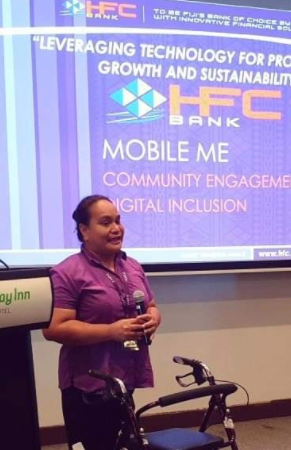
Georgina Sakimi-Naigulevu (2020 Board member) brings a strong background in banking for her role as Board Treasurer. Georgina is a strong advocate for the regional Pacific Disability Forum [PDF 2020] in Fiji. She is pictured speaking in March 2020 at the Fiji National University’s conference “Leveraging Technology for Productivity Growth and Sustainability” about a community engagement project that promotes digital inclusion for persons with disabilities. She attended the APRICOT meeting in Melbourne [PICISOC, 2020d] and brought the perspective of the disabled into many of her interventions. She has since established links with ISOC’s Accessibility SIG [A11YSIG, 2020] and Gunela Astbrink (Vice President of the SIG in Australia) who has had a long association with PICISOC. “When PICISOC ran annual PacINETs, I was invited to hold workshops and presentations on accessibility for persons with disability over several years. Maureen was a champion in ensuring that the disability voice was heard at these events”. Now, PICISOC, the PDF team, ISOC’s Accessibility SIG and the IGF Dynamic Coalition on Accessibility and Disability (DCAD) [IGF, 2020a], are collaborating to develop ways to meaningfully dialogue online with audiences that include people with disabilities. The inclusion of captioning and sign language interpretation, using interpreters from the PDF team, are being proposed to ensure that all virtual meetings are accessible for people with disabilities.

Image for post
Kanaan Ngutu, Kiribati

Kanaan Ngutu is the Senior ICT Officer at the Ministry of Information, Communication, Transport and Tourism Development, Government of Kiribati. His background brings Cybersecurity and e-Government initiatives and experience to the Board, but he is also involved in the buildup of e-Commerce environment for Kiribati, ICT in Education, and the improvement of the Government Finance Management Information System. He also serves as the correspondent on Cybersecurity works with regional and global bodies such as Oceania Cybersecurity Center [OSCS, 2020] and Get Safe Online [GSO, 2020]. He has attended various ICANN and Internet Society meetings as well as actively represented the Pacific at the DC-SIDS sessions of the Global IGF.

e-TALANOA

Image for post

Supported by the Board, PICISOC member and former Board member, Will Tibben from the University of Wollongong organised the first e-Talanoa which was a traditional discussion forum (but online) to discuss “FOSS: it’s free, its open but how does it work?” His speakers came from Tonga, Fiji, and Australia, to present their contributions before discussing issues raised by the other 16 participants in true talanoa (roundtable) tradition. Edwin Liava’a (Former PICISOC Board Chair, 2014), from Tonga works for Kacific Broadband Satellites as Regional Director for the Pacific and collaborates with a number of regional agencies in the Pacific in project delivery and capacity building. Kenneth Katafono (PICISOC member, from Fiji) founded a Fijian traceability tech start-up, TraSeable Solutions, which supports global food sustainability by providing a blockchain-ready software-as-a-service (SaaS) platform for fisheries and agriculture traceability. Both Kenneth and Edwin believe that accessibility and affordability in the Pacific, are connected to “bigger picture” issues about wholesale and retail availability of broadband, and more particularly by government regulation. Ashley Maher, a Director to the Australian Computer Society, concluded that with regards to the uptake of FOSS in the Pacific, “It takes time for new ideas to emerge, be communicated and then be accepted. One factor that constrains FOSS is the reality that many IT specialists who have developed their careers on Windows are not going to voluntarily make their store of knowledge redundant by introducing new concepts. Learning new concepts takes time and effort — it’s much easier to stick with the familiar.”

Maureen Hilyard: President, Cook Islands Internet Action Group; Chair, At-Large Advisory Committee (ALAC, ICANN); Chair, DotAsia Board of Directors; Member, Pacific Islands Chapter of the Internet Society (PICISOC); Member of the Public Interest Registry (.org) Advisory Committee (PIRAC); Diplo Foundation IG Graduate.

November 13, 2020

Join us for our next e-talanoa: e-Learning and the Pacific
In this Talanoa, we will take a broad view of e-Learning such that any use of ICTs or Digital Technologies in teaching and learning and administration of the Education System will be included. This is sometimes called ICT for Better Education (ICT4BE).

The format will be a one hour Zoom Meeting with four guest speakers speaking for 10 minutes each, followed by a Q&A session. Its main focus will be on the Pacific Islands, but also draw on good practice from Pacific neighbours and other developing regions.

We hope the Talaona will help to:-

• Refocus initiatives to have a stronger focus on student learning outcomes and supporting teachers
• Share experiences between MoEs and ICT staff to see what works and what doesn’t in the Pacific context
• Manage the expectations of what can be accomplished in the short, medium and long term (5 years+)
• To help demo the upfront / recurrent costs involved to allow for MoEs to make realistic budget decisions

Click this link to register:
https://bit.ly/35pxbpP

November 9, 2020

The Second Pacific Women in ICT Virtual Meetup saw an introduction to IGF with our women IGF experts in the region. A total of 18 Pacific Women in ICT attended to listen, learn and collaborate online.

Sylvia Cadena spoke on her experience with the Global IGF where different individuals, societies and/or organisations have different perspectives on what the internet means to them, how the internet works for them, and how they use the internet. Cadena sees the IGF space as a life boat that will help the Pacific Women in ICT and others to find the right way to bring the internet to help people and keep things in perspective. Participants were also reminded that many different individuals and organisations see, experience and build the internet from different perspectives.

“The internet is everywhere, we all are still learning how to make it ours and how to make it better for the future” is the message that Slyvia Cadena left behind with the PICwICT.

Other interesting points from Cadena’s presentation are:

  • IGF is a space where discussions happen once a year
  • Multi-stakeholder approach is used in this space where civil society, private sector and academia concerns can be voiced in a same level playing field. Cadena briefly shared her experience on how to keep the room accountable in a multi-stakeholder approach.
  • IGF over the years has made a strong effort to build national & regional participation in under-represented countries and under-represented regions to be considered. Bringing diversity with meaning such as finding them in gender diversity, geography diversity, stakeholder group, points of view diversity and find a way to make it civil and make the conversation productive with positive outcomes.
  • Positives of having the internet:
    • The internet brought Cadena to a different country to be what she is today,
    • The internet got Cadena to connect to other people in the world, Pacific Women in ICT, families and friends living afar. Internet does keep us connected.

Anju, on the other hand spoke on her role and experience with the Asia-Pacific Regional IGF and the Pacific IGF and agreed with Cadena that IGF is a growing platform, we need people with common sense and be realistic with the way we approach things, and don’t have to always agree to everything but making sure we find a common goal to translate some of these discussions into policies or even action oriented projects. Some interesting take away from this speaker are:

  • Asia-Pacific Regional IGF (APrIGF)
    • A platform to discuss and collaborate on issues at the regional level
    • National IGF discussions and/or ICT or internet related discussions are brought into this space to advance the internet governance development in Asia-Pacific region
    • Can apply for a fellowship determined by your experience in the internet and ict related work
    • To be enthusiastic and passionate about ICT and the work that we do in our country/region and how we can translate these from the national to the regional and all the way to the global IGF.

Anju encouraged PICwICT to be enthusiastic participants in these Internet Governance Forums and be the voice at the Global platform where Pacific is under-represented. “Stay informed, Be the Pacific Voice” is the message for the session.

The final speaker was Dalsie Baniala who shared her experience on the National IGF (VAN IGF) and her role in the MAG. It was interesting to learn that Dalsie has a background in Psychology and Business Administration but with her interest and passion was able to venture down the IGF and MAG pathway and acknowledges some of the Women in ICT as her role model in this journey. Interesting points taken from Dalsie’s presentation are:

  • National IGF in Vanuatu
    • Vanuatu IGF institution was established in 2018
    • The institution is currently financially supported by the Regulator’s Office and the Prime Minister’s Office to help maintain the Secretariat and to promote more internet activities across the nation.
    • A lot has been achieved in 2018-2019 and quite more can be achieved however with the covid19 pandemic, this has affected activities lined up
    • Key stakeholders of the Vanuatu IGF are: The Police, The ministry of Education, Ministry of community services, Schools and users.
    • It is open to the public to become a member of the VAN IGF. This approach taken as a pull factor to keep interest and people in this space.

Dalsie has been a MAG member since 2018 and encouraged the PICwICT to become a member as it has help developed and broaden her understanding that assist her to contribute to ICT and internet related discussions that affects the Pacific Island Countries. Her experience with MAG has also assisted her in contributing to the Vanuatu Digital Government Roadmap on data privacy and government integration network.

The message Dalsie left behind was, “Be open minded in all the discussions as you are not only representing the organisation or employee that you work for but also representing the community that you are part of.”

The participants were also privileged to hear experiences from Maureen, Swaran and Cherie on their journey in this space and the encouragement to join the Diplo Foundation. For more on Swaran’s experience please refer to this link: https://picisoc.org/2020/10/25/personal-blog-aprigf-2020/

November 5, 2020

Ms Cherie Lagakali, Chair

My name is Cherie Lagakali, I am a Database Consultant currently collecting information for APNIC Foundation’s pactraining workshops to be held in the Pacific in 2020.

I first joined PICISOC in 2008, received a NetHui Fellowship in 2015 and became a PICISOC board member 2017-2019.  During my tenure on the board I have represented PICISOC in ICANN ALS, maintained dialogue for cybersecurity mapping initiatives in the region and joined the organizing committee for PacIGF.

I am an ICANN 63 and ICANN 65 Fellow, moderate the PICISOC mailing list and am also the webmaster for PICISOC site with Emani Lui.

On the board this year we began an initiative celebrating Pacific Women in ICT; promoting the stories of Pacific Women and their contribution to the community. Through this initiative we helped shed light on the difficulties faced by women in the area of ICT also promoting and encouraging other women to join the field.

I personally feel that there are still so many untold success stories in the area of ICT just waiting to be discovered – both men and women and I’d like to promote those stories. I also feel that PICISOC can be a medium of generating the right discussions in the area of cybersecurity, network security, network monitoring and analysis and just plain keeping the network up and running in the Pacific islands.

If we all just started talking to each other, we’d realise that we’re all facing or have encountered the same issues and somebody may have the solution for someone else while someone may have a better way of doing something and we could all progress together as a region.

I find and enjoy the ability to link a need to a resource and bringing people together to solve problems. I feel that the Pacific has generated a lot of interest in the last few years and I’d like to help make sure that the focus is on the right things and places where the need is and where there is a potential to make a difference, change a community, change lives!

Ms Georgina Naigulevu, Co Vice Chair/Treasurer

I am an active Fiji Community member with a strong background in software development in the banking industry and would love the chance to give back by volunteering my advisory and technical skills.

I am a Software Developer by profession and work with clients on an individual basis to explore ICT Solutions to help their businesses.

I have also have a strong background in the financial sector and possess a broad range of ICT skills.

In addition one of my areas of expertise is in financial digital inclusion.

I am a strong advocate of Women In ICT and to creating digital businesses for Persons with Disability as well as promoting local Entrepreneurship within Fiji and the Pacific Region.

I have co-founded Community Project – Mobile Me Mapathon for Fiji to create an accessibility map of Suva as a pilot in partnership with our local Disability People Organizations.

Mr Kanaan Ngutu, Co Vice Chair/Webmaster

Kanaan Ngutu is a Government of Kiribati official working as a Senior ICT Officer at the Ministry of Information, Communication, Transport and Tourism Development. He is working on e-Government and Cybersecurity projects for the Government. He graduated from the University of the South Pacific in 2014 with a Bachelor degree in Computer Science and Information Technology. 

An alumni of the International Coperation for Assigned Names and Numbers (ICANN), Kanaan has participated in two ICANN meetings, ICANN 60 and ICANN 63 and also been to the Internet Governance Forum in 2016 and 2019. He is a current chair of the Kiribati Computer and Internet Society.

Mr Timoci Tuisawau, Secretary/Linkedin Page Manager

This image has an empty alt attribute; its file name is 6EYooc2wthcNmjspjMMBSqduKGeeyRRpqpYQbiVKD5Ru3OtEA4CxwaRjV_S1YYooA7CKRJ8eRcZxvi0u646yXIJq4dj8dxXnVTMQMAViexBeB_ArCu-8ob8lbXpvM7XsJMMX7AQd

Having worked in various sectors (public, private and NGO) in the country I have experienced various aspects of how technology is applied and used across these sectors. Each sector is a specialty on its own and has its own set of challenges in terms of IT. Taking a cross section of this there are commonalities that may also be found in challenges faced. Having attended many workshops, meetings, education and discussions across the region and globally I have also found that many of these challenges face on a sectoral and national level are also common across regions. This is where I believe that my contribution as a member of the board of PICISOC would be most valuable. To be able to give advice and contribute to policy and processes on a national and regional level is where many of these challenges may be evaluated, investigated, addressed and monitored.

In terms of experience, over the years, I have experience across the whole spectrum of IT. I started out as a programmer and have gained certifications in oracle databases. I moved on to systems and networking and have a wide experience across servers, storage networking and systems. I have worked in the infrastructure field of data networks with practical and certification in network and voice cabling (UTP and fibre), wireless networking, radio backbone links, satellite technologies, Video, Voice, routing and switching. Across the whole stack of IT I have worked on designing, configuration, implementation and maintenance of the whole suite of technologies. Amongst the certifications achieved I was certified as a CDCP and CDCS from Singapore. This helped me design the Fiji Governments Tier 3 Data Centre, the first of its kind in the country and the Pacific region (excluding Australia and New Zealand).

I have extensive experience and field work in projects and project management. Over the past years I have led teams of people and helped promote self evaluation and high performance across many landscapes.

Ms Seluvaia Kauvaka, Facebook Page Manager

This image has an empty alt attribute; its file name is bqrCDhWkLF-_DHIpdiP9E8m8o__5ZN9IXbfyQw-GcobLzKA0hkJQO_SKfB5FUBLPqfk-TORhZWrXb52LmNwjtsgIsQV-AH0TX2To54BJiKJdrrQLcDEQQx6podURzeEN0PV7mc-j

Malo e lelei and Greetings, I am Seluvaia (Selu for short) Kauvaka from the friendly islands of Tonga.

I am currently the Chief System Analyst for the Ministry of MEIDECC (Meteorology, Energy, Information, Disaster Management, Environment, Climate Change, Communications and CERT). I previously worked for 7 years in Digicel Tonga Limited and 3 years for Digicel Samoa Limited as their Senior IP Engineer. I am passionate about learning new technologies and sharing new techniques. I’ve been a member of PICISOC for quite a while now and would like to step up and be part of the Board as I noticed there aren’t any Tongans currently in the Board, I want to push and revive work in Tonga actively through PICISOC.
    I am a network engineer by background but one of those ITs who has come a long way from support helpdesk from reformatting, cabling, configuring and routing, you name it. I am a strong advocate for Women in ICT.  Ive started an NGO named Tonga Women in ICT (TWICT) that started in 2018, with a mission of “Empowering women and girls to engage with information and communication technologies (ICT’s) in a range of exciting ways and fully participate in the ICT industry. “I am also the current Chairlady of this NGO. I am currently the lead engineer pushing projects NICT (National ICT) and E-Government in the Tongan Government today. Looking forward to the day this is fully deployed and see how technology has made a difference in the Government work moving forward.
    I enjoy very much sitting down with fellow ICT members – male and female – to talk and discuss valuable solutions for the nation (Tonga) even the Pacific as a whole. Ive been involved in many international and regional meetings and workshops from ICANN, APNIC, PACNOG, IGF, and many more. I’m very passionate about a better ICT world in the PACIFIC and I want to actively help push support ideas and be a part of this development alongside other Board members to develop a better robust and more communicated ICT world in the Pacific.
    If I am elected, I want to be more involved which, means pushing Tonga to be more involved in sharing Pacific ideas.

Mr Andrew Molivurae, Chapter Rep/Pacific IGF Rep

This image has an empty alt attribute; its file name is jxlVZK7aH7yuBIj3fQ2djhis36l4uy4wzaAZTX3oXeA8vR-of72PDD_6t6hiMp57tl3aISf7RWCe5pMvXbqryhVwSaYSyfqlG5BhEcYB5qw8zZqCnlwFJwMD8ThMZwgBmNgAaTm5

Andrew Molivurae is a Ni-Vanuatu working full time at the Telecoms and Broadcasting Regulator’s Office as Senior Internet Governance Officer.  He has been a member of the Pacific Chapter of the ISOC since 2004, was a Board member from 2007 to 2011 and was Chair and Vice Chair of the PICISOC Board from 2009 to 2011. He has participated in many international ICT meetings like ICANN, APrIGF, Pacific IGFs, IETFs, APTLDs, PICISOC events (PacINET) and some other International ICT events. Andrew has also recently been a fellow at the 13th European Summer School on Internet Governance (EuroSSIG). Having served on the board for over 7 years Andrew is keen to stay on for another term not only to volunteer more time for PICISOC, but also to provide mentoring and advice to the incoming board.

Ms Letitia Masaea, Mailing List Admin

A current member and one of the founders of Women in IT Solomon Islands (WITSI). With the arrival of the undersea cable to Solomon Islands, Letitia has been instrumental in promoting Cyber Awareness to the younger generation during school visits, careers day and Girls in ICT Day events that occurs annually. Letitia is also heavily involved in promoting Information, Communication and Technology (ICT) careers and opportunities amongst women and girls in the Solomon Islands with the aim to inspire and kindle ICT interest, empowering young girls to choose an ICT career path and to encourage IT women to retain their interests in this field with the aim to help build the ICT network and industry.

As the current data quality officer with the Pacific Islands Forum Fisheries Agency (FFA), Letitia has been involved in conducting trainings for regional fisheries MCS officers on FFA products that have been developed and rolled out to member countries for utilisation. This includes the need for capturing correct, accurate, valid and complete data in a timely manner, mapping and re-engineering business processes and procedures accordingly as technology and the environment changes, all which will greatly assist with decision making in the fight to curb illegal, unreported and unregulated fishing.

October 27, 2020

The GFCE has appointed Cherie Lagakali as the GFCE’s first Pacific Liaison. This role and appointment follows the GFCE’s first Pacific Regional Meeting, held in Melbourne in February 2020 and in the margins of the OCSC-GCSCC 2020 Global Cybersecurity Capacity Building Conference.

The GFCE Pacific Regional Meeting provided an opportunity for donors, project implementers and Pacific Island nations to discuss common goals, identify opportunities and challenges for cyber capacity building in the region. The meeting further provided an opportunity for the GFCE to listen and discuss ideas on how the GFCE could support future cyber capacity building initiatives in the region.

Participants at the first GFCE Pacific Regional Meeting

From the GFCE’s perspective the meeting identified two types of ‘gaps’ in the Pacific:  gaps in specific areas of capacity building and opportunities to improve coordination and information sharing between Pacific Island countries, regional and international donors and implementers.

An article on the GFCE Pacific Regional Meeting and the core themes that emerged can be found on pg. 42 of the 7th edition of the Global Cyber Expertise Magazine.

To address the two gaps identified, the GFCE has now launched a short scoping assessment for a future GFCE Pacific Hub, led by Cherie Lagakali as the new GFCE Pacific Liaison. The broad aims of a future Hub will be to:

  • facilitate national and regional cyber capacity building coordination and information sharing;
  • support national cyber capacity building efforts; and
  • enable refinement, prioritisation, and access of cyber capacity building needs

Importantly any GFCE Pacific Hub must look to fill a gap, rather than replicate or duplicate existing regional mechanisms and structures in the Pacific. A Hub will be responsible for supporting Pacific Island countries, as well as advising local regional/international donors on Pacific Island needs and coordinating with existing regional structures and mechanisms, rather than attempting to replicate them.

The success of any future Hub will be twofold – (i) ensuring a Hub is about the Pacific and works for Pacific Island countries and (ii) galvanises Implementers and Donors, in the Pacific region, to coordinate and share information on their local investment, skills and CCB (Cyber Capacity Building) programmes.

In taking up the role of GFCE Pacific Liaison, Cherie outlines that her role will be to:

“Work with the Pacific to develop a GFCE Hub that is designed by the Pacific and for the Pacific. A Hub that will assist in improving coordination, collaboration, knowledge sharing, and transparency among Pacific Island nations and between Pacific Island nations, regional donors, and implementers. The GFCE must avoid just being another additional actor in an already crowded field and will aim to design a Hub that efficiently and effectively meets the needs of the Pacific; providing tangible, meaningful, and operational cyber capacity building support for the region.”

Cherie Lagakali, GFCE Pacific Liaison

This article first featured on the GFCE website.
Link: ​https://thegfce.org/the-gfce-looks-to-the-pacific/

  • « Go to Previous Page
  • Page 1
  • Interim pages omitted …
  • Page 7
  • Page 8
  • Page 9
  • Page 10
  • Page 11
  • Interim pages omitted …
  • Page 38
  • Go to Next Page »

Footer


Physical Address
of the Chapter
+1-111-111-111

© 2026 Internet Society Chapter

Copyright © 2026 · Internet Chapters on Genesis Framework · WordPress · Log in

  • Home
  • About Us
  • Board Business
  • Events
  • SIGs