
• Skip to primary navigation
  • Skip to main content
  • Skip to footer
Picisoclogo

PICISOC.niue.nu

The Internet Society in the Pacific

Search

Search DropdownSearch Icon Join
  • Home
  • About Us
    • What is PICISOC?
    • History of PICISOC
    • PICISOC Members
    • Code of Conduct
    • PICISOC Netiquette Guidelines
  • Board Business
    • Current PICISOC Board Members
  • Events
    • PacIGF 2023
    • Pacific Internet Governance Forum (PacIGF)
    • PacINET
    • International IGF Reports
    • ICANN Meeting Reports
    • Pacific Regional Meeting Reports
  • SIGs
    • Research and Development Partners
    • Pacific Islands Education
    • Pacific Islands FOSS
    • Pacific Islands GIS/RS
    • Pacific Islands Internet Freedom

TWiICT joins ITU in celebrating ‘Girls in ICT Day 2020: Inspiring the Next Generation’

TWiICT joins ITU in celebrating ‘Girls in ICT Day 2020: Inspiring the Next Generation’

As originally posted on the portal of the Government of the Kingdom of Tonga

23rd April, 2020 

Tongan Women in Information and Communications Technology (TWiICT) formerly known as CoConeck joined an online dialogue on Girls in Information and Communications Technology (ICT), hosted by the International Telecommunication Union (ITU) of the United Nations to commemorate ‘Girls in ICT Day – April 23, 2020’ under the theme of ‘Inspiring the Next Generation’.

Few members of the Tongan Women in ICT (TWiICT)

The event was set to celebrate in Samoa this year but due to the outbreak of the 2019 Novel Coronavirus, ITU came up with a resolution to celebrate virtually through online dialogue.

The theme highlights the importance of governments’ engagement in empowering women through technology and draw attention to role models, mentors and how they can inspire girls and young women to take up careers in the tech field.

ITU Secretary-General, Mr. Houlin Zhao said Information and Communication Technologies, are at the heart of the response to the unprecedented crisis we are facing and digital technologies is a key ally in combating COVID-19.

“They have kept people safe, productive, and connected as the world grinds to a halt. In this turmoil, Girls in ICT Day is a ray of hope. It is the hope of all these young women and girls around the world who see in tech the promise of a better future, not just for themselves but for all people and communities around them. No virus, no matter how powerful, can ever diminish that hope.”

Mr. Zhao stressed the need for all governments, businesses, university leaders and others to give these young women and girls the chance to achieve their dreams.

“Learning must not stop during this crisis. Come join ITU and our partners to support remote learning and ensure the vital telecommunication networks they rely on; are resilient, now and long after we have defeated this disease.”

“Girls in ICT Day is your day, to inspire many of you to start the journey to the fascinating world of information and communication technologies.”

The Chief Executive Officer for the Ministry of Meteorology, Energy, Information, Disaster Management, Environment, Climate Change and Communications (MEIDECC), Mr. Paula Pouvalu Ma’u said, Tongan Women in ICT planned to conduct a half-day workshop with guest speakers, panellists, invited guests and students to celebrate ‘Girls in ICT Day 2020’ in Nuku’alofa, but all has been postponed to next year.

“Tongan Women in ICT however created a short video titled ‘Tongan Women in ICT Celebrate Girls in ICT Virtually 2020’ to mark the day instead. We need to promote and encourage Women in ICT, and even in the leadership role. It’s good for them, and also good for us here in Tonga for our economic, social development and communications.”

Mr. Ma’u said there is a need for more women engineers and technicians in this field. “I believe women play an important role in promoting ICT here in Tonga and to the whole world.”

The Chief Executive Officer for the Ministry of Education (MET) Dr Tangikina Moimoi Steen advised Tongan Women in ICT to stand together and strongly advocate for government’s policies and regulations that will protect us from the abuses of ICT.

“Those who use our technologies to abuse and victimize people online and especially young Tongan girls, we are here as women because there were women before us who protect us. Now it’s our duty to protect the next generation of Tongan girls in particular from abuses of ICT. We need to act now and develop appropriate policy for schools, for the workplaces, and for any Tongan community that are using ICT.”

Members of the Tongan Women in ICT (TWiICT) are currently working as computer programmers and network engineers in line ministries and the private sector.
April 27, 2020

As originally posted on the portal of the Government of the Kingdom of Tonga

23rd April, 2020 

Tongan Women in Information and Communications Technology (TWiICT) formerly known as CoConeck joined an online dialogue on Girls in Information and Communications Technology (ICT), hosted by the International Telecommunication Union (ITU) of the United Nations to commemorate ‘Girls in ICT Day – April 23, 2020’ under the theme of ‘Inspiring the Next Generation’.

Few members of the Tongan Women in ICT (TWiICT)

The event was set to celebrate in Samoa this year but due to the outbreak of the 2019 Novel Coronavirus, ITU came up with a resolution to celebrate virtually through online dialogue.

The theme highlights the importance of governments’ engagement in empowering women through technology and draw attention to role models, mentors and how they can inspire girls and young women to take up careers in the tech field.

ITU Secretary-General, Mr. Houlin Zhao said Information and Communication Technologies, are at the heart of the response to the unprecedented crisis we are facing and digital technologies is a key ally in combating COVID-19.

“They have kept people safe, productive, and connected as the world grinds to a halt. In this turmoil, Girls in ICT Day is a ray of hope. It is the hope of all these young women and girls around the world who see in tech the promise of a better future, not just for themselves but for all people and communities around them. No virus, no matter how powerful, can ever diminish that hope.”

Mr. Zhao stressed the need for all governments, businesses, university leaders and others to give these young women and girls the chance to achieve their dreams.

“Learning must not stop during this crisis. Come join ITU and our partners to support remote learning and ensure the vital telecommunication networks they rely on; are resilient, now and long after we have defeated this disease.”

“Girls in ICT Day is your day, to inspire many of you to start the journey to the fascinating world of information and communication technologies.”

The Chief Executive Officer for the Ministry of Meteorology, Energy, Information, Disaster Management, Environment, Climate Change and Communications (MEIDECC), Mr. Paula Pouvalu Ma’u said, Tongan Women in ICT planned to conduct a half-day workshop with guest speakers, panellists, invited guests and students to celebrate ‘Girls in ICT Day 2020’ in Nuku’alofa, but all has been postponed to next year.

“Tongan Women in ICT however created a short video titled ‘Tongan Women in ICT Celebrate Girls in ICT Virtually 2020’ to mark the day instead. We need to promote and encourage Women in ICT, and even in the leadership role. It’s good for them, and also good for us here in Tonga for our economic, social development and communications.”

Mr. Ma’u said there is a need for more women engineers and technicians in this field. “I believe women play an important role in promoting ICT here in Tonga and to the whole world.”

The Chief Executive Officer for the Ministry of Education (MET) Dr Tangikina Moimoi Steen advised Tongan Women in ICT to stand together and strongly advocate for government’s policies and regulations that will protect us from the abuses of ICT.

“Those who use our technologies to abuse and victimize people online and especially young Tongan girls, we are here as women because there were women before us who protect us. Now it’s our duty to protect the next generation of Tongan girls in particular from abuses of ICT. We need to act now and develop appropriate policy for schools, for the workplaces, and for any Tongan community that are using ICT.”

Members of the Tongan Women in ICT (TWiICT) are currently working as computer programmers and network engineers in line ministries and the private sector.

April 27, 2020

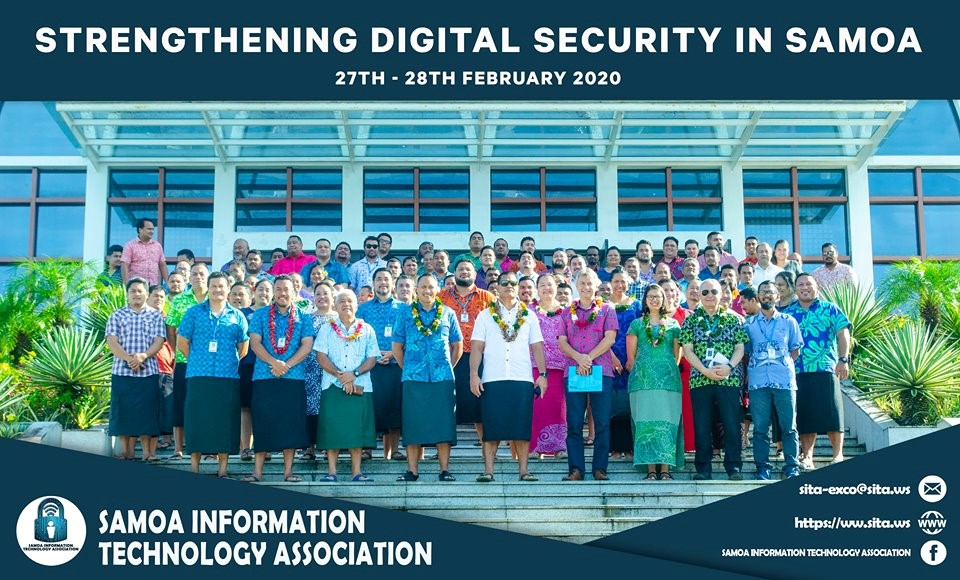
The Samoa Information Technology Association (SITA) is hosting its first National Seminar and Workshop on the 27and 28 of February 2020 to be held at the Samoa Convention Center, TATTE Building, Sogi.

The goal of the Seminar and Workshop is to strengthen and build awareness of Digital Security in Samoa. To promote how to secure data communication and network infrastructure.

Day one of the Seminar will see a variety of stimulating presentations on cyber security in various contexts, showcasing practical information and advice on reducing cyber risk, preventing breaches and protecting data. International presenters include personnel from; UpGuard, APNIC and CERT NZ.  There are also planned presentations from local ICT related business, government entities such as; Digicel Samoa, Attorney General’s Office, Central Bank of Samoa, Bluesky Samoa, Computer Services Limited, BitSolution, and SkyEye Samoa for both technical and non-technical audiences.

Day two is the hands on workshop conducted by the APNIC representative. This will give participants best practice scenarios about digital security to keep information safe and secure.

The President of SITA, Mr.Muliagatele Fainuulelei James Ah Wai had said that the number of registrations was far beyond his expectations with a lot of interest shown from both the business community and civil society.

The keynote speaker, is the Hon. Afamasaga Rico Tupai Minister of Communications and Information Technology. Other invited guests included members of the Diplomatic Corp, government officials, members of the business community and civil society.

SITA takes this opportunity to thank all its partners and sponsors for their generous support and advice leading up to the launch, including but not limited to; Hon. Afamasaga Rico Tupai Minister of Communications and Information Technology, Fualau Talatalaga Mata’u Matafeao, Chief Executive Officer, CSL, MCIT, Bluesky Samoa, Digicel Samoa, National University of Samoa (Media Unit), SSAB, Greenology, Com-Tech Extra, Tokelau office, Pacific Technologies, Vailima Breweries, Taumeasina Island Resort and the Office of the Electoral Commission.

April 21, 2020

(Special Edition)

Written by: Cherie Lagakali, Board Secretary, PICISOC (Pacific Island Chapter of the Internet Society); and Klee Aiken, GFCE Advisory Board member.

In February 2020, the GFCE held its inaugural regional Pacific event in Melbourne, in the margins of the OCSC-GCSCC 2020 Global Cybersecurity Capacity Building Conference. During the event, donors, project implementers and Pacific partners discussed a common goal of identifying and addressing opportunities and challenges for cyber capacity in the region. This article aims to give insight on the three core themes that emerged from these collaborative discussions: coordination, contextualization and commitment; and opportunities for further engagement with the Pacific communities.

In the third week of February, the Asia-Pacific Internet community descended on Melbourne for a number of events including APRICOT 2020, APNIC 49, APTLD 77, the OCSC Global Cybersecurity Capacity Building Conference and a FIRST Technical Colloquium. In such a crowded field, the GFCE managed to stand out with a lively, solution-oriented Pacific Regional Forum. The event was bolstered by the gracious support of OCSC, Global Partners Digital, and the World Bank; Forum partners and members who helped with logistics and the travel costs for Pacific delegates. For anyone working on cyber capacity building through the GFCE or in the Pacific, the room was full of familiar faces, however for most, the inaugural GFCE Pacific event was the first introduction between the different communities. With a bit of boldness in the agenda, the group was able to draw out frank insights to address a common goal of identifying and addressing opportunities and challenges for cyber capacity building in the region.

Pacific Delegates at GFCE’s first regional meeting
PC: Alifeleti Tu’ihalamaka (Tonga)

From these discussions three core themes emerged: Coordination; Contextualization, and Commitment. While these themes are hardly unique to the Pacific, in collaboratively unpacking them in Melbourne, the group was able to gain a richer understanding of each. This resulted in a better appreciation for the different perspectives of donors, implementers, and Pacific partners, as well as, the opportunity to begin exploring pragmatic solutions to improve the way we work.

Click to continue reading (on page 42) as originally published in the Global Cyber Expertise Magazine vol. 7 – special edition

April 20, 2020

Originally posted on A4AI – Alliance for affordable internet

This post was written by A4AI Asia-Pacific Regional Coordinator Anju Mangal.

Joining the Web Foundation team as a Pacific islander has been an interesting socialisation experience and a great learning process. As a woman passionate about the ICT sector and the Internet Governance process, it’s been an important journey to learn about the work and tools used by my new colleagues to advocate for policy change and closing the digital divide.

I’ve joined the diverse and dynamic Alliance for Affordable Internet (A4AI) team at a crucial time when the Asia-Pacific region records some of the highest digital divides on the continent. Targeted interventions are needed to speed up progress and I am fortunate to work with colleagues and key experts in the region to facilitate policy and regulatory dialogues and drive action that leads to meaningful connectivity and affordability. 

The Asia-Pacific region can benefit largely from meaningful and affordable connectivity. However there remains a number of barriers to achieving this. Namely, three factors continue to hinder digital development in the region: geographical challenges such as island archipelagos, the growing digital gender gap and broadband affordability. As a Pacific islander, connecting people who do not have the opportunity to be online is a top priority for me especially those living in rural and remote communities. 

The Asia-Pacific region is unique and diversified, surrounded by a luscious, natural environment which spreads across the Pacific Ocean. Geographically, it has large populations with dispersed island archipelagos, particularly in the Pacific areas. The Fiji submarine sea cable system is one that  connects two big islands but not other islands due to the high costs and investments. Additionally, it can be challenging for internet service providers to maintain infrastructure and communications during natural disasters, which occur often. Despite the advance of new emerging technologies, the region still suffers from a lack of affordable and meaningful access to the internet in part due to these geographical challenges. 

Further, the gender gap is still widest in South Asia at 51%. In Bangladesh and Pakistan, there’s still a lack of family approval for women to be online. In all Asian countries surveyed for the GSMA Mobile Gender Gap Report, women were less likely than men to own a smartphone. The biggest barrier to mobile internet adoption across the countries surveyed in Asia, for both women and men is affordability, literacy and digital skills. There’s still a lot to be done to bridge the gender gap and ensure that women have access to affordable internet. 

Our 2019 Affordability report also shows Asian countries are progressing towards affordability but the scores still remain lower than the global average. At least 16 out of 25 Asian countries have affordable access to the internet. And only 15 countries outline targets of connectivity in their broadband plans.

Many vulnerable people, such as those living with disabilities, in developing countries have lower incomes and  cannot afford expensive internet rates or expensive assistive technologies. Access to affordable internet access creates important opportunities to close the digital divide, particularly for women and girls, rural and remote communities, and persons with disabilities. 

In order to foster an environment that allows for meaningful and affordable internet in the Asia-Pacific region, it’s important to challenge the mindsets of the people in-charge of making key decisions. Introducing and encouraging the multistakeholder coalition model can help bring more Pacific islanders online. A4AI’s multi-stakeholder coalition model, aims to bring together stakeholders to participate in dialogue and policy decision-making processes to make the internet more accessible to people around the world.

In my role at A4AI, I aim to build an open collaborative process with stakeholders from different sectors, to design locally driven policy solutions, advance healthy market competition, develop flexible and forward looking policy and regulatory instruments and encourage public consultation and transparency that will help foster increased connectivity in the Asia- Pacific region.

I very much look forward to engaging with key players and experts in the Asia Pacific region and coordinating events and activities that use a multi-stakeholder process to determine the best solutions and strategies to tackle the digital divide in the region.  Observing the various interactions and team dynamics, as well as understanding the cultural and political context and who has the most influence is imperative. As the Asia-Pacific lead, I aim to create successful coalitions in the region and I hope I can count on all players to build a successful movement of A4AI members and partners who together advocate for the policy frameworks that will support digital development and opportunity to the people in the region. 

There are also several tools and resources at disposal for the benefit of the Asia Pacific community, such as the recently launched A4AI Rural Broadband Policy Framework: Connecting the Unconnected report. This is especially important given the number of unconnected populations living in rural areas, about 14% in rural areas compared to 42% in urban areas among Global South countries. 

Again, collaboration amongst different players and organisations can be powerful and I hope my Asia-Pacific colleagues will join me to continue to amplify A4AI’s efforts in the region.  We need a sustainable, collaborative and collective effort in bridging the digital divide in Asia-Pacific. If we all work together, we will go a long way toward bridging the digital divide in Asia-Pacific. I hope to find common ground to drive change and continue to build trust in key stakeholders, especially across great distances. 

I am ready for this chapter and hope you are ready to join me! 

April 20, 2020

The Asia Foundation is exploring the launch of a Pacific Islands COVID-19 Misinformation Project – a regional program examining how the spread of online misinformation and rumors related to COVID-19 has affected pandemic response in Pacific Islands nations. The goal of the project is to identify broad misinformation trends on COVID-19 topics and evaluate how stakeholders in the region can work together to reduce the risk of online misinformation that threatens to undermine the COVID-19 response.

The Asia Foundation plans to support the development of this research program, a survey of experts and policymakers in the region, and the compilation of a report describing its findings. This is intended to be a rapid assessment of current information ecosystems in the region, and it will be carried out over the course of approximately eight weeks in April, May, and June 2020. The overall design of the survey along with the project trajectory will be developed in consultation with regional experts and policy professionals based in the Pacific. 

If you would like to participate in or support the project in any capacity, we welcome comments from all parties.

About The Asia Foundation: The Asia Foundation is a nonprofit international development organization committed to improving lives across a dynamic and developing Asia-Pacific region. Its work across the region addresses five overarching goals—strengthen governance, empower women, expand economic opportunity, increase environmental resilience, and promote international cooperation. In Pacific Island nations, the Foundation’s programs combat domestic violence, help prepare communities for effective disaster management, and support cybersecurity cooperation. Since 2018, The Asia Foundation and APNIC have supported technical training and conferences in Papua New Guinea on cybersecurity and internet governance issues.

April 20, 2020

PICISOC – ICANN collaboration

In January 2020, the Chairs of ICANN’s Advisory Committees (ALAC, SSAC and RSSAC) and Supporting Organisations (GNSO, CCNSO and ASO) met with the ICANN Board Chair – Maarten Botterman – and ICANN’s President and CEO, Goran Marby.   The meeting was for the Constituency Leaders to convey to the Board and ICANN Org what their priorities were for 2020.

This meeting followed on from a successful ATLAS III (our third At-Large Summit meeting) in Montreal in November, so that most of our planning was based on achieving follow-up activities which were established at the meeting of over 40 members of the ALS organisations who had completed a policy learning programme which was a pre-requisite to applying to be one of the team to attend the ATLAS meeting at ICANN66.  This included a report on the programme based on the survey and reports by the ATLAS participants , as well as further policy development, outreach and engagement activities and capacity-building development within the regions to grow further understanding of the work that At-Large does in ICANN, as well as to hopefully engage more participants in our activities within ICANN as well as in our own communities.

One of the proposals that I raised was a project specifically for the Pacific.

ICANN Learn has been working hard to develop courses that are aimed at building knowledge about the key interest areas of learning based around the domain name system which is the responsibility of ICANN.

In April 2020, a call was made to PICISOC and the Pacific ALSes to identify interest in learning more about ICANN. Within a week we had 14 participants who had put their names forward to participate in a learning programme that focuses on key areas of concern to end-users. Ten of the participants are from Fiji and currently three are from Papua New Guinea.

The first course that they are undertaking is “Registrant Basics” to give some context to why ICANN is important to those who are using the Internet, particularly those who have their own domain name. Following the start of this course, the group will meet on a monthly basis on a zoom call (sponsored by the PICISOC Board Chair) to discuss any issues related to the studies that they have taken, but also to discuss any questions that they may have about getting engaged in ICANN-related activities. These will initially involve APRALO (the Asian, Australasian and Pacific Islands Regional At-Large Organisation) as well as the wider At-Large community and ALAC (the At-Large Advisory Council) meetings and activities.

It is planned that over the next few months, the group will study Cybersecurity, an Introduction to ICANN, DNS Fundamentals, as well as introductions to different sections of the ICANN community, before moving to Policy Fundamentals and Policy Development within At-Large. In the middle of all this, will be another virtual conference in June (22-25) which will provide a practical online learning experience for students about what ICANN does.  Progress updates from the students themselves will also be encouraged on the PICISOC notices.

  • « Go to Previous Page
  • Page 1
  • Interim pages omitted …
  • Page 16
  • Page 17
  • Page 18
  • Page 19
  • Page 20
  • Interim pages omitted …
  • Page 38
  • Go to Next Page »

Footer


Physical Address
of the Chapter
+1-111-111-111

© 2026 Internet Society Chapter

Copyright © 2026 · Internet Chapters on Genesis Framework · WordPress · Log in

  • Home
  • About Us
  • Board Business
  • Events
  • SIGs